
•••
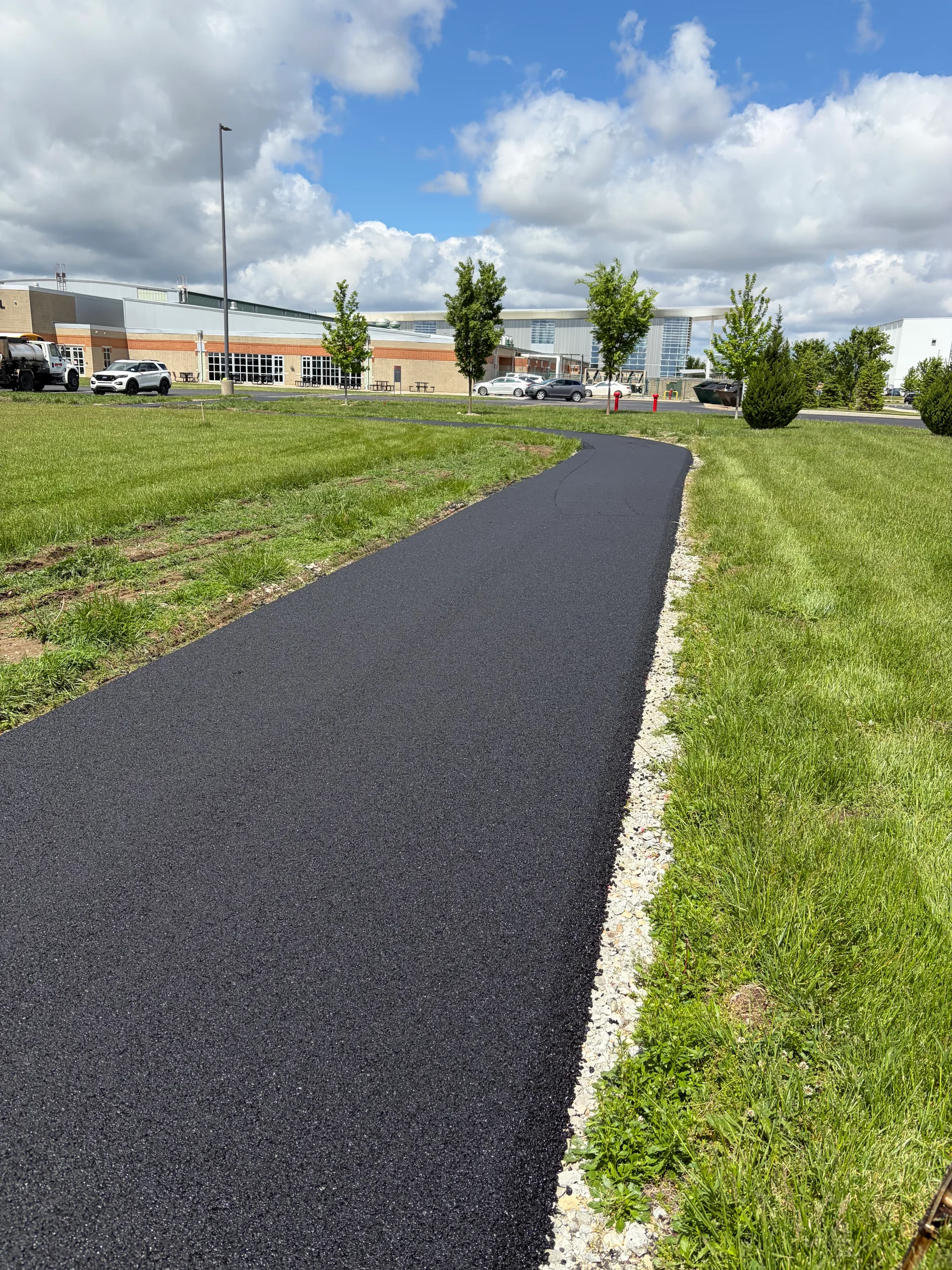
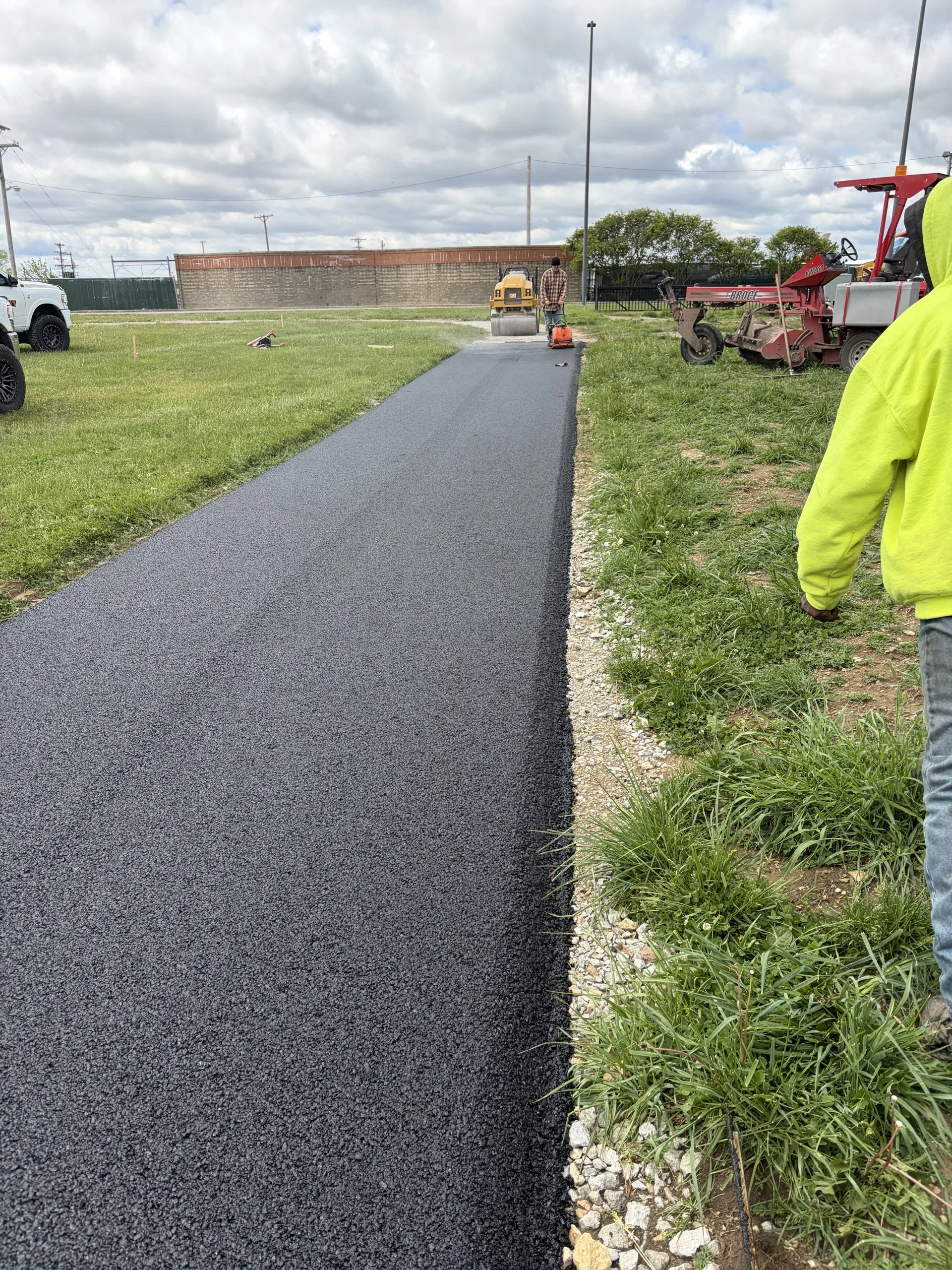
Finished asphalt walking path curving toward the Laurel Oaks Career Campus building, with limestone shoulder stone along its edge
PavingSouthwest OhioCincinnatiTOP-C purple wordmark logo for The Ohio Purchasing Council cooperative purchasing program

Laurel Oaks Walking Path Pavement 2026

Laurel Oaks Career Campus in Wilmington now has a paved walking path that runs more than a third of a mile around the grounds — an eight-foot asphalt route wide enough for two people side by side, a mower, or a class walking out to a lab. Prodigy Building Solutions designed and built it under a pre-bid cooperative contract, placing roughly sixteen thousand square feet of new asphalt in a single mobilization on a campus that never closed for it. Great Oaks Career Campuses ran the job the way an owner with its own grounds crew should: the district shaped and compacted the subgrade, Prodigy proof-rolled it and paved it, and the district restored the shoulders behind the paver. The work was accepted complete in the spring of 2026.

A hard-surface loop is one of the few site improvements on a career campus that pays back to every program at once. It gives health and fitness classes somewhere to run that is not a road shoulder. It gives students on foot a route between buildings and lots that stays usable after rain, when mown turf does not. It gives grounds and maintenance staff a path their own equipment can drive without rutting the lawn. And it is one of the few outdoor amenities a district can add without touching a building, a roof, a mechanical system or an occupancy permit.

What made this one straightforward was the split. Great Oaks already owned the equipment and the ground to do its own earthwork, so the contract put subgrade preparation, compaction and final restoration with the district and left Prodigy with the paving — proof roll, two compacted inches of ODOT Item 448 surface course in one lift, and hot-tar-sealed joints. That is not a shortcut; it is a boundary drawn where each side is faster, with written conditions on the seam between them so nobody is guessing what "prepared subgrade" means the morning the trucks show up.

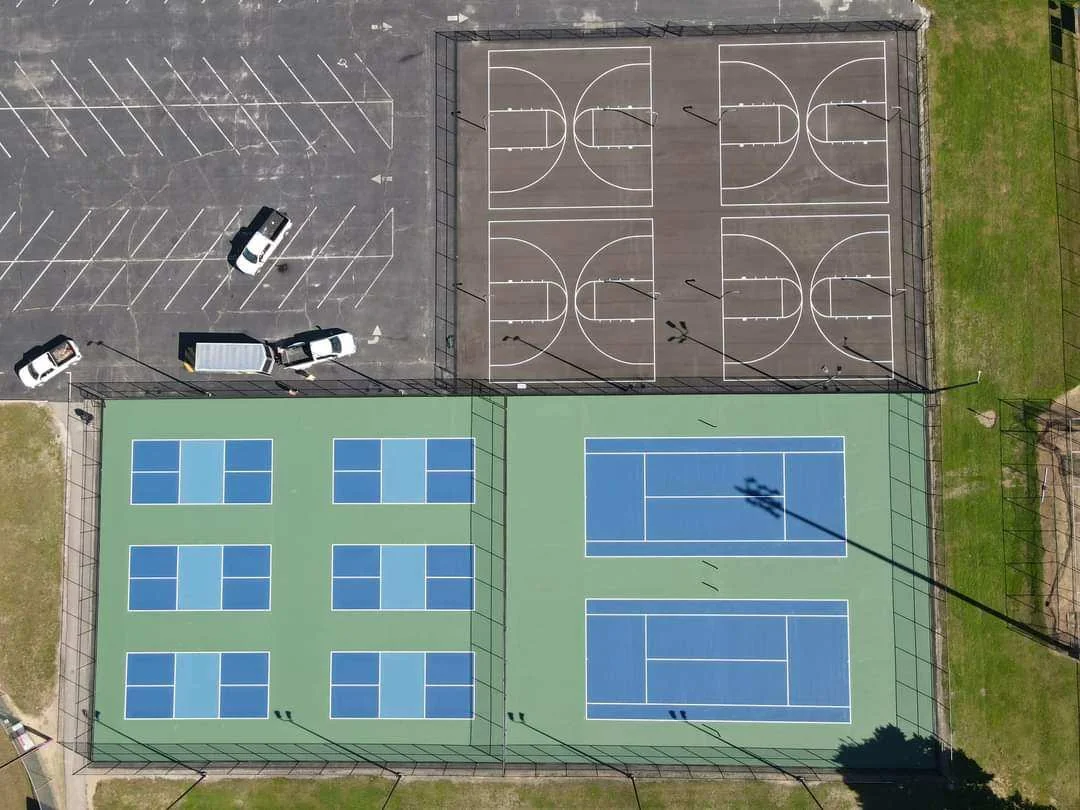
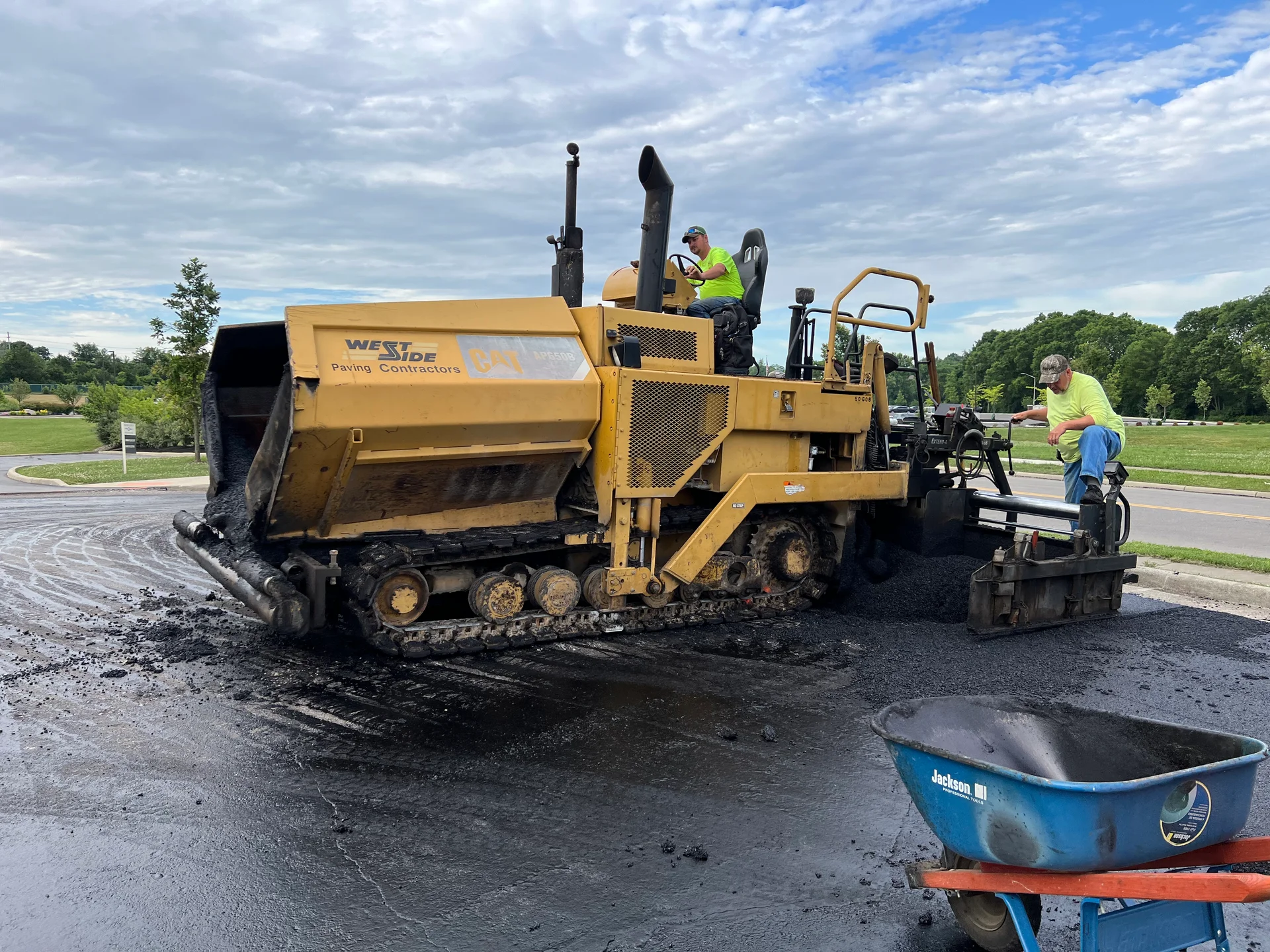
Prodigy paves for districts, career campuses, municipalities and county agencies across Southwest and Central Ohio — parking lots, drives, bus loops, tennis and pickleball courts, and paths like this one — through cooperative contracts that are competitively bid before a district ever calls. If there is a route on your campus that people already walk and the grass shows it, that is usually the alignment worth pricing.
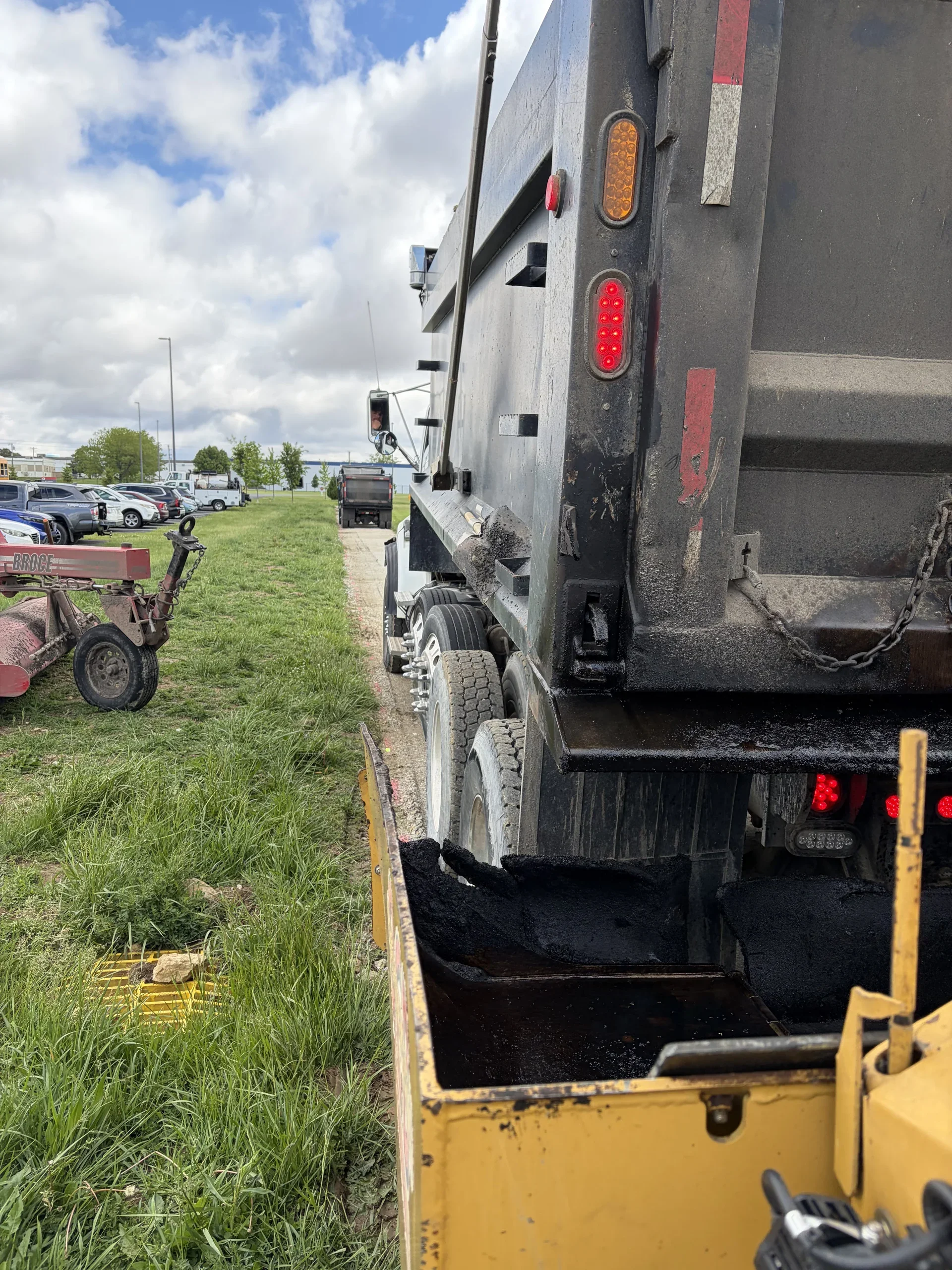
Dump truck discharging hot asphalt into the paver hopper along the Laurel Oaks walking path alignment
Freshly placed asphalt mat on the new walking path with limestone set tight against the compacted edge
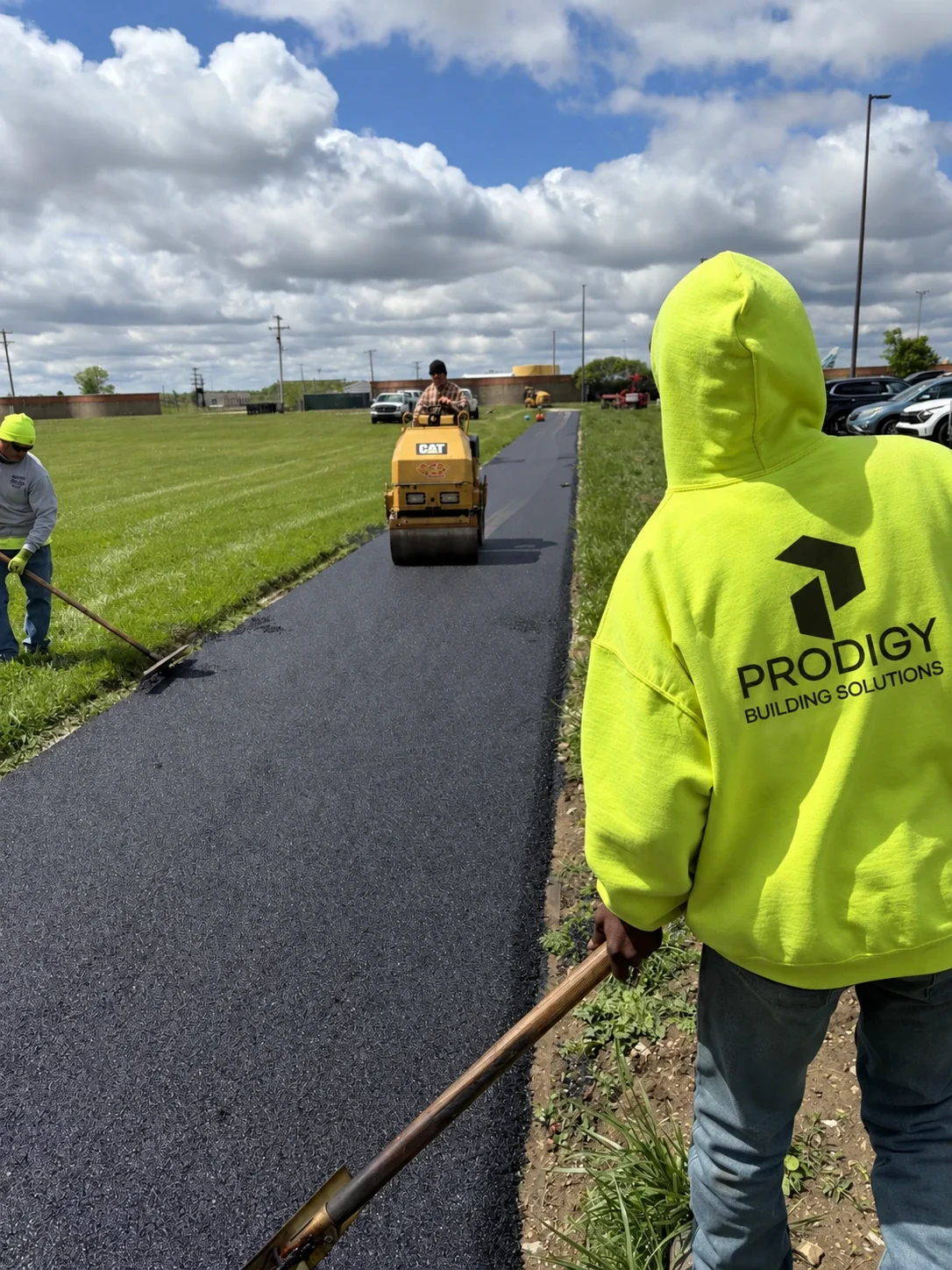
Double-drum roller compacting the walking path while a worker rakes the asphalt edge at Laurel Oaks

Technical Discussion

The path is two inches thick. The part that matters is nine feet wide.

Price a new campus walking path with a conventional pavement section and you get a road: six inches of ODOT #304 aggregate, three compacted inches of #301 base course, a tack coat, and an inch and a half to two inches of #448 surface. Ten and a half inches of material, because that is the section that gets specified for anything a vehicle can reach. This path is two compacted inches of #448 placed in one lift directly on prepared subgrade, and nothing underneath it at all.

The reason is load. Aggregate base and asphalt base course exist to spread wheel loads down into the subgrade so the soil never sees a concentrated pressure it cannot carry. A walking path does not have wheel loads worth spreading — it carries people, a zero-turn mower, a utility cart, and once in a while a pickup that should not be there. Building a truck section under it buys structural capacity that nothing on the site will ever demand, on the largest square footage of the project. A district that specifies a drive section for a path is paying parking-lot money for a sidewalk.

What has to be true instead

Take the structural layers out and every bit of the performance moves to the subgrade, which is why the two conditions written into this contract are the ones worth copying.

The first is the proof roll. Before any mix is placed, the area to receive asphalt is loaded and watched for pumping, rutting and deflection. On a ten-inch section a soft pocket is a problem the base course can bridge. On a two-inch section there is nothing to bridge with — a soft spot telegraphs through as a depression, the depression holds water, and water in a two-inch mat is the whole failure sequence. The proof roll is the hold point where that ground gets found and fixed instead of paved over, and it costs an hour.

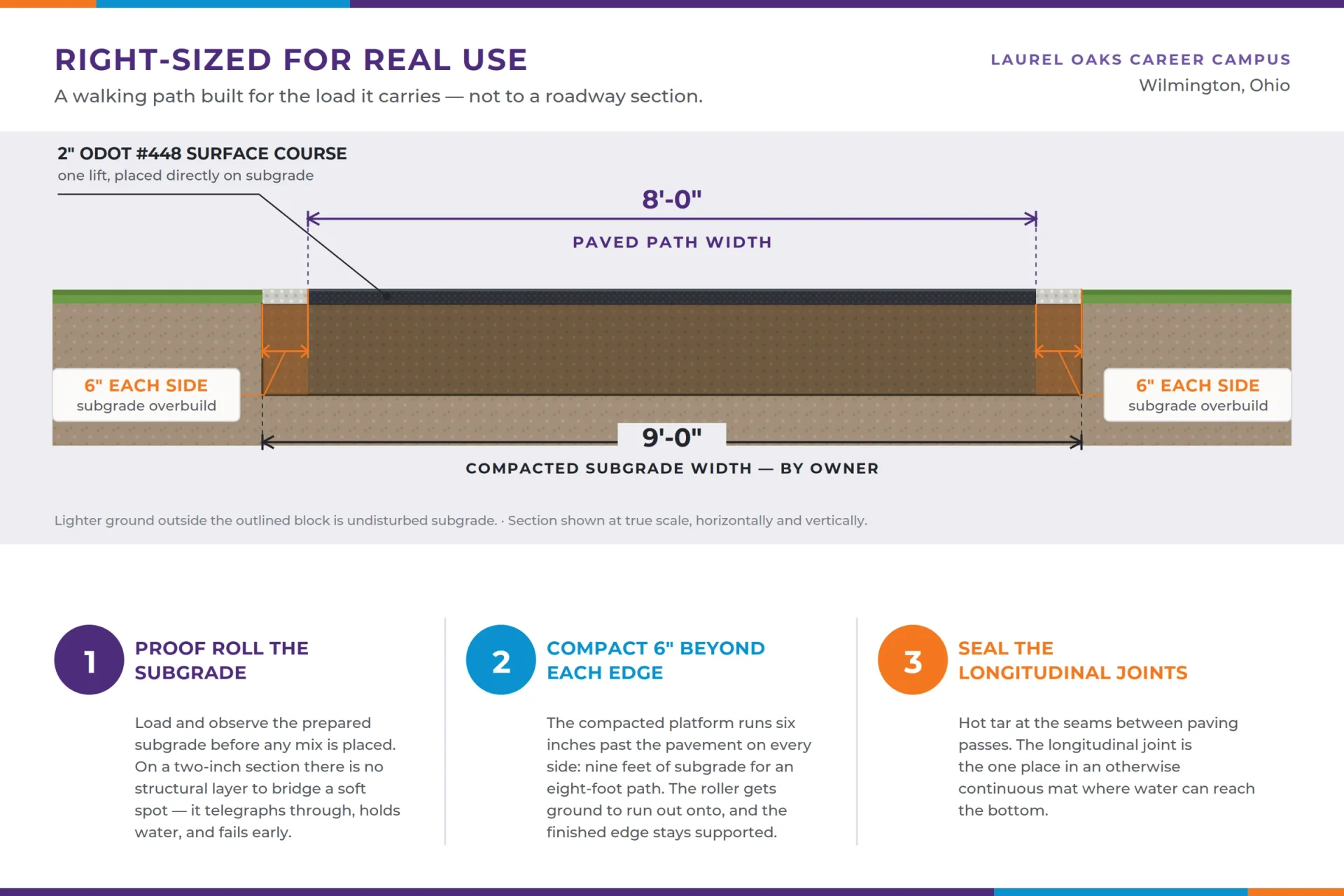
The second is the one people skip: the compacted subgrade has to extend at least six inches past the paving on every side. An eight-foot path has two free edges and no curb holding either of them. The roller cannot compact the outer inches of a mat against thin air, so an edge built on a platform cut to exactly eight feet finishes low in density on both sides — and low density at an unconfined edge is where raveling starts, where mower tires break the corner off, and where frost gets underneath. Compacting nine feet of platform for eight feet of path gives the roller ground to run out onto and gives the finished edge continuous support beneath it. The limestone the district set tight against the edge afterward closes it out. The section below shows both widths at true scale.

Cross-section of the walking path: a 2-inch ODOT #448 asphalt surface course 8 feet wide, laid in one lift on a 9-foot compacted subgrade platform that extends 6 inches past the pavement on each side, with numbered notes on proof rolling the subgrade, compacting past each edge, and sealing the longitudinal joints.
Figure 1 — An 8-foot path on a 9-foot compacted platform. The 6-inch overbuild on each side is what gives the unconfined pavement edge continuous support.

The joints get hot tar because a path is paved in passes, and a longitudinal joint between two passes is the one seam in an otherwise continuous mat where water can find the bottom.

The practical version, for a facilities director pricing a path on their own campus: the thickness on the proposal is the least interesting number on it. Ask who is compacting the subgrade, how far past the pavement edge that compaction runs, and whose signature is on the proof roll. A path built two inches thick on ground that was proved and overbuilt at the edges will outlast a thicker one laid on ground nobody looked at.

Our Work

Similar Projects