
•••
TheatersSouthwest OhioCincinnatiTOP-C purple wordmark logo for The Ohio Purchasing Council cooperative purchasing program

Monroe High School Theater Renovation Phase 1 2026

The Monroe High School auditorium came out of summer 2026 with an all-LED, full-color stage lighting rig, a flown line-array sound system, wireless intercom and new stage curtains. Prodigy Building Solutions engineered and delivered the theater systems as one package: LED ellipsoidals, hex PARs, moving heads and cyclorama bars on a new networked lighting system with simple house controls, self-powered line-array speakers and subwoofers flown left and right, a networked backstage stage box, a fully wireless Clear-Com system, work-light control from the booth and backstage, new curtains, a rigging inspection and the electrical conversion behind it all. It was procured through Monroe Local School District's TOP-C cooperative contract.

The project started with the people who use the room most. Prodigy sat down with the district's theater and music staff, built a wish list, and priced it into two phases the district could fund. Phase 1 took on the infrastructure: lighting, sound, communication, curtains and power. Phase 2, planned for summer 2027, brings new seating and stage components.

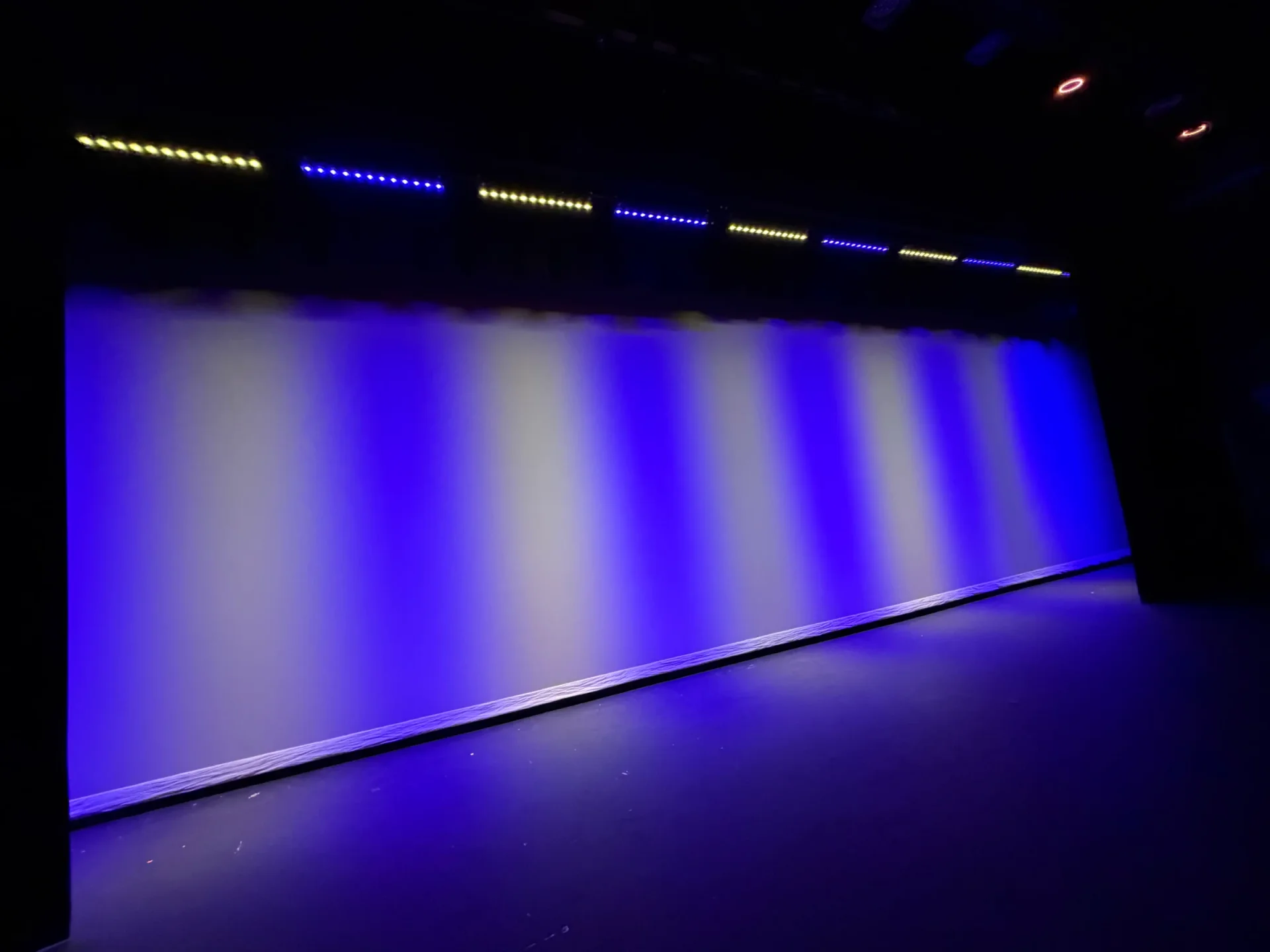
The lighting is the change the audience sees first. Every theatrical fixture on the stage electrics is now LED and color-mixing, so a director can wash the cyclorama in any color, throw gobo patterns across the stage floor and move light during a scene without a crew on a ladder refocusing between shows. A network decoder sits at every lighting position, with spare ports and switches, so the system can grow without pulling new cable. House controllers let a teacher bring up a usable stage look for an assembly or rehearsal without touching the main console.

The sound system was rebuilt around self-powered line-array speakers and subwoofers rigged above the stage to cover the seats evenly, and a networked stage box gives the booth more inputs from backstage while the existing stage plugs stay in service. The wireless Clear-Com means the booth, the stage manager and the backstage crew talk without cables run across the deck.

The schedule was fixed by the school calendar. The electrical conversion and the installation were finished in the summer break, before the first day of the 2026–2027 school year.

Monroe now has a theater its staff and students can run from the booth or from a wall panel, built in a way that leaves room for Phase 2 and for whatever the next production needs.
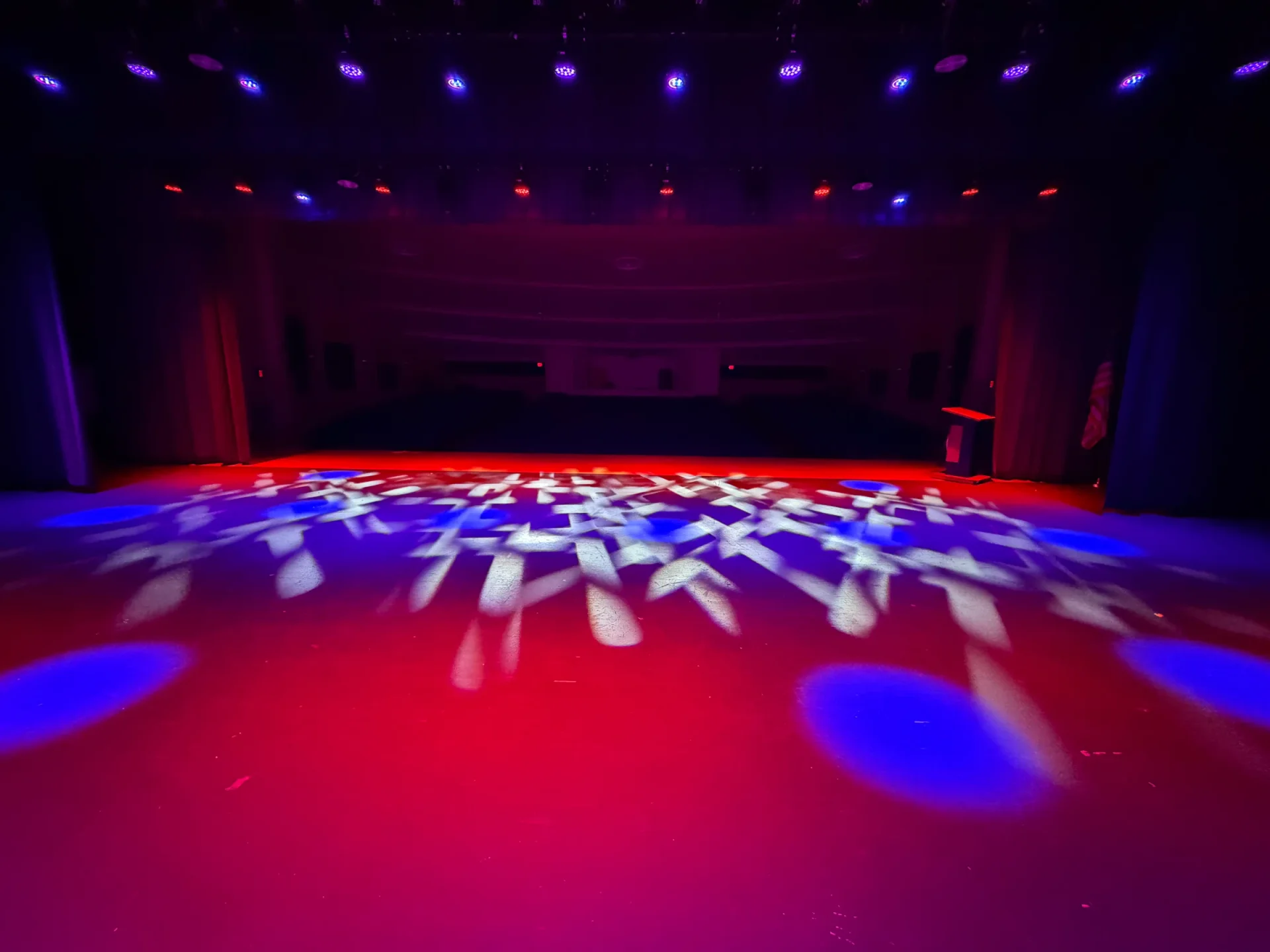
Stage floor washed in red with blue pools and white gobo patterns from the new LED moving heads
LED cyclorama bars lighting the upstage drop in alternating blue and white bands
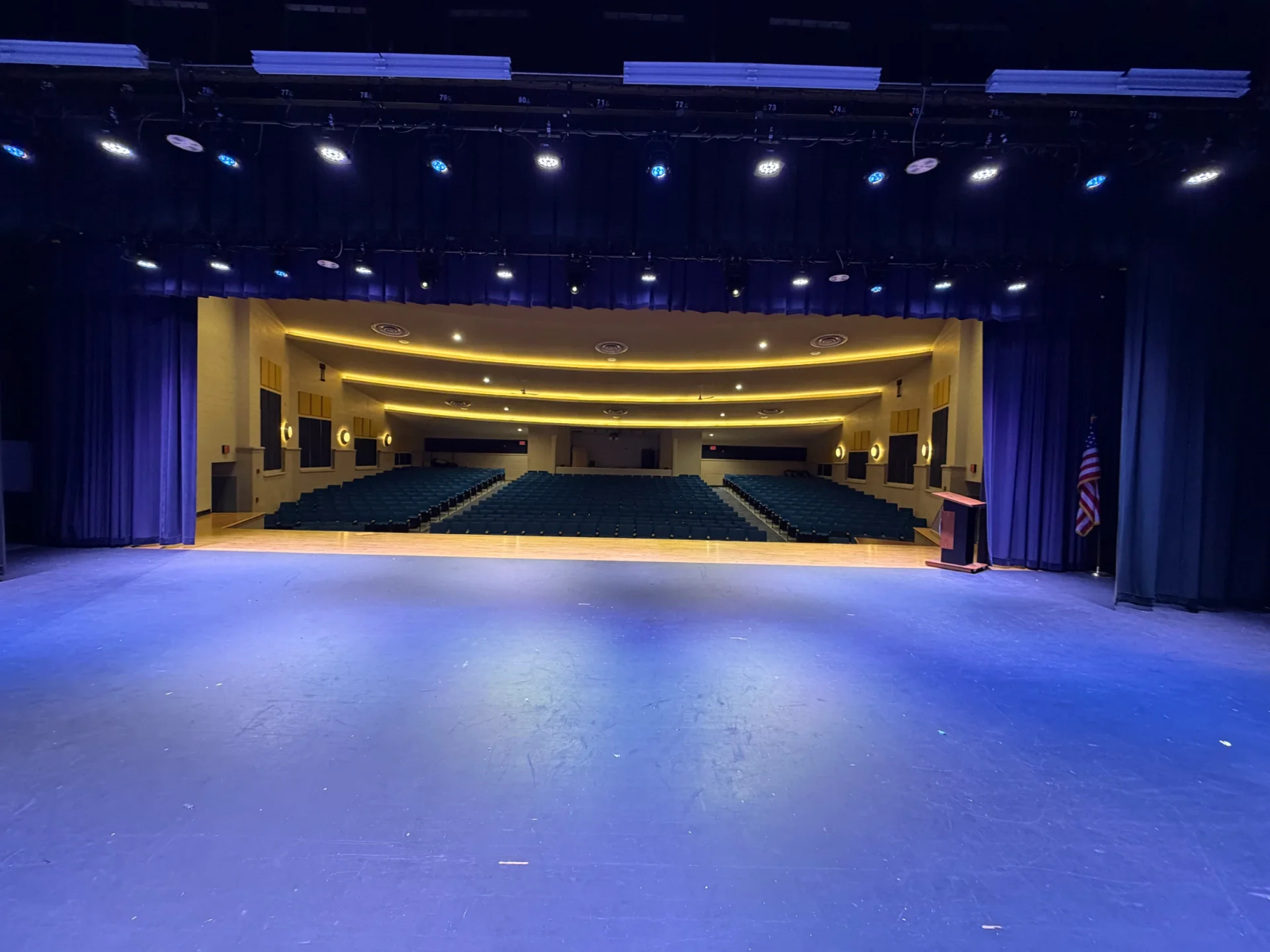
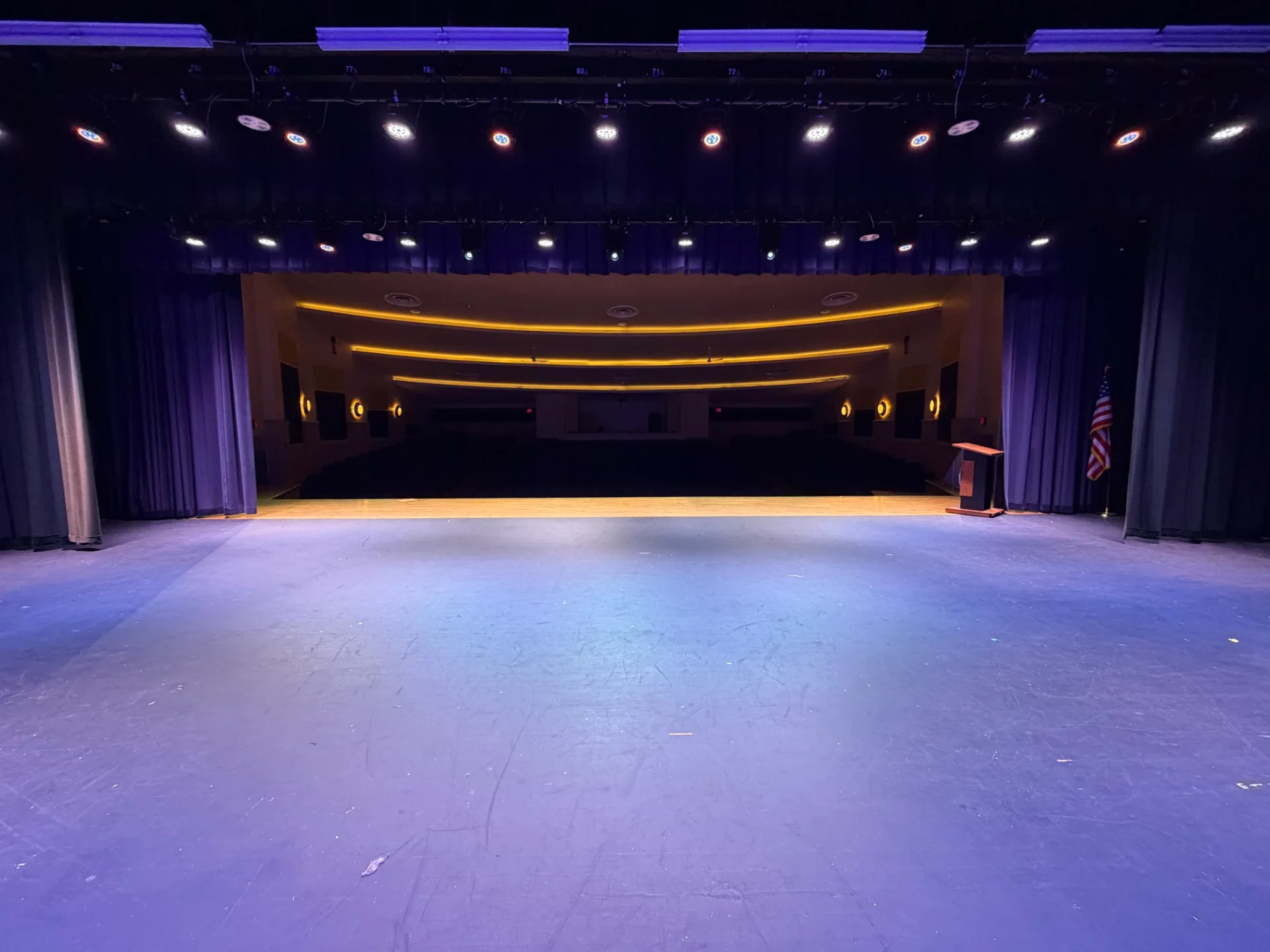
View from upstage toward the auditorium seats, with LED fixtures along the electrics overhead and the new stage curtains
The stage under a cool LED wash with the house lights down and the auditorium's curved ceiling coves glowing warm

Technical Discussion

From a Dimmer per Circuit to Power plus Data

A theater built for incandescent light puts the dimming in a rack. Every lighting position is wired back to its own dimmer, and the dimmer controls the lamp by chopping the AC waveform it sends down the wire: cut off half of each wave and the lamp runs at roughly half. The wire to the fixture is the control signal. A standard 20-amp dimmer on 120 volts carries 2,400 watts, about four 575-watt ellipsoidals, so a stage needs a large rack and a large electrical service behind it. Older rooms went further and used a patch panel, because there were more circuits than dimmers and a crew had to plug circuits into the dimmers each show needed.

Why the Dimmer Has to Come Out of the Path

An LED fixture does its own dimming. It has a power supply and electronics inside that set the brightness and mix the color, and it wants clean, steady power. The dimmer manufacturers say so directly: most LED fixtures and moving lights need unregulated power, and running them through a dimmer's SCR wears out their power supplies. A dimmer can be set to pass power through, but ETC's own guidance is that a relay or constant-power module is the better choice, because a dimmed channel can still be pulled down by accident from the console.

So the LED stage is wired differently. Each lighting position gets plain constant power, switched on and off by a relay, and a separate low-voltage data line tells each fixture what to do. That data is DMX512, which runs 512 control channels per line at 250 kilobits per second. A moving head can use a dozen or more of those channels by itself, which is why the data no longer runs as one long daisy chain from the console.

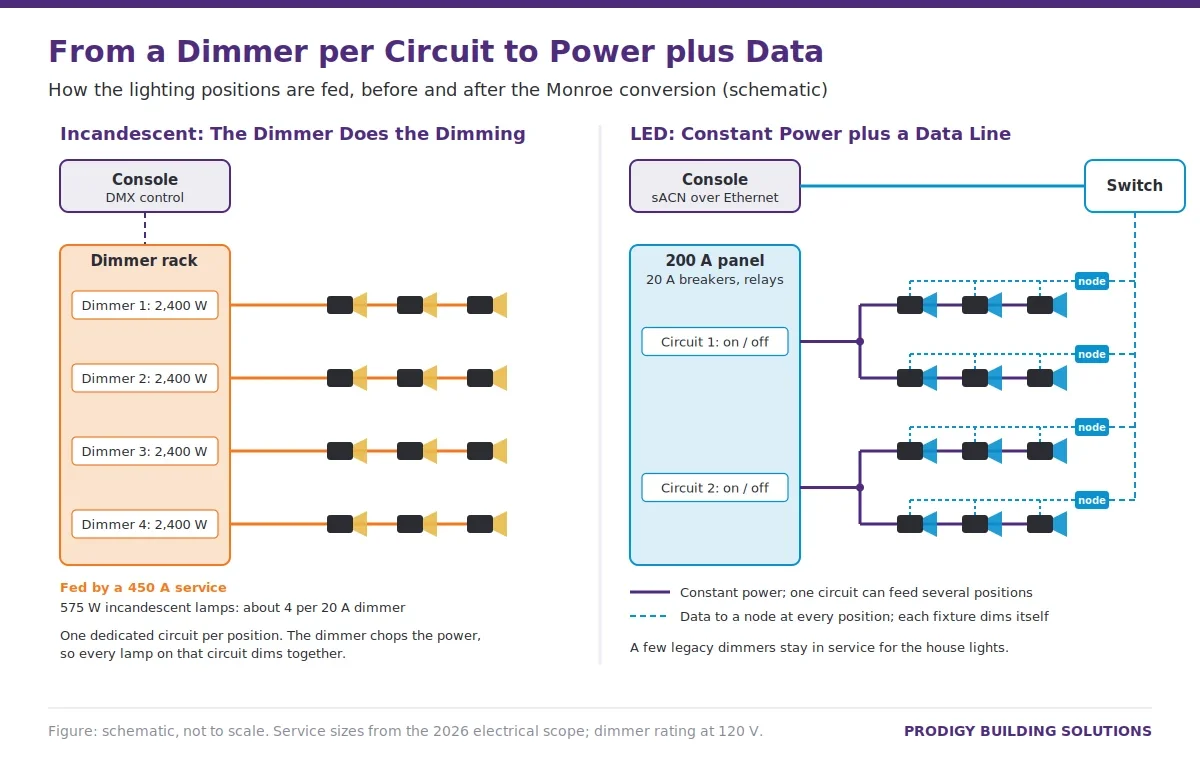
Side-by-side schematic. Left, incandescent: a console sends DMX to a dimmer rack fed by a 450-amp service, and four 2,400-watt dimmers each run one dedicated circuit to one lighting position of three lamps. Right, LED: a 200-amp panel of 20-amp breakers and relays feeds two constant-power circuits that each serve two positions, while the console sends sACN over Ethernet to a switch and a node at every position that runs data to each fixture. A few legacy dimmers remain for the house lights.
Figure 1 — The dimmer leaves the circuit: constant power to every position, and a network decoder at each one.

What Monroe Built

At Monroe the console talks to the stage over sACN, the standard that carries DMX on an Ethernet network. Network switches feed a decoder at every lighting position, so each position gets its own clean data line and a new fixture or a new position is a port on a switch rather than a new cable to the booth. sACN can carry thousands of DMX universes, far more than this room will ever use.

The power side got smaller. The old dimmer cabinet was fed from a 450-amp service. The electrical contractor disconnected it, took out one set of the parallel feeder conductors, and installed a 200-amp panel of single-pole 20-amp breakers that now feeds the relay circuits to the stage. A few legacy dimmer packs stay in service for the house lights and the handful of incandescent fixtures the district kept.

The result is that brightness, color and movement now live in the fixtures and the network, and the electrical system only has to keep the power on. That is why an LED retrofit is a wiring change and not only a fixture swap.

Customer Testimonial

Rob Kramer

Monroe Local School District · Director of Business Operations · 21 hours ago

Rob Kramer, Director of Business Operations at Monroe Local School District, talks about the two-phase renovation of the Monroe High School auditorium. Phase 1 was finished in summer 2026 and covered the theater's infrastructure: lighting, sound and curtains. He describes how Prodigy started with the people who use the theater most, gathered their wish list, brought in experts, and put together a package the district could fund in two phases, with new seating and stage components coming in Phase 2 next summer. Monroe had worked closely with Prodigy on another project, and he calls the team efficient and communicative, with experts who helped the district shape a project it is proud of.