
•••
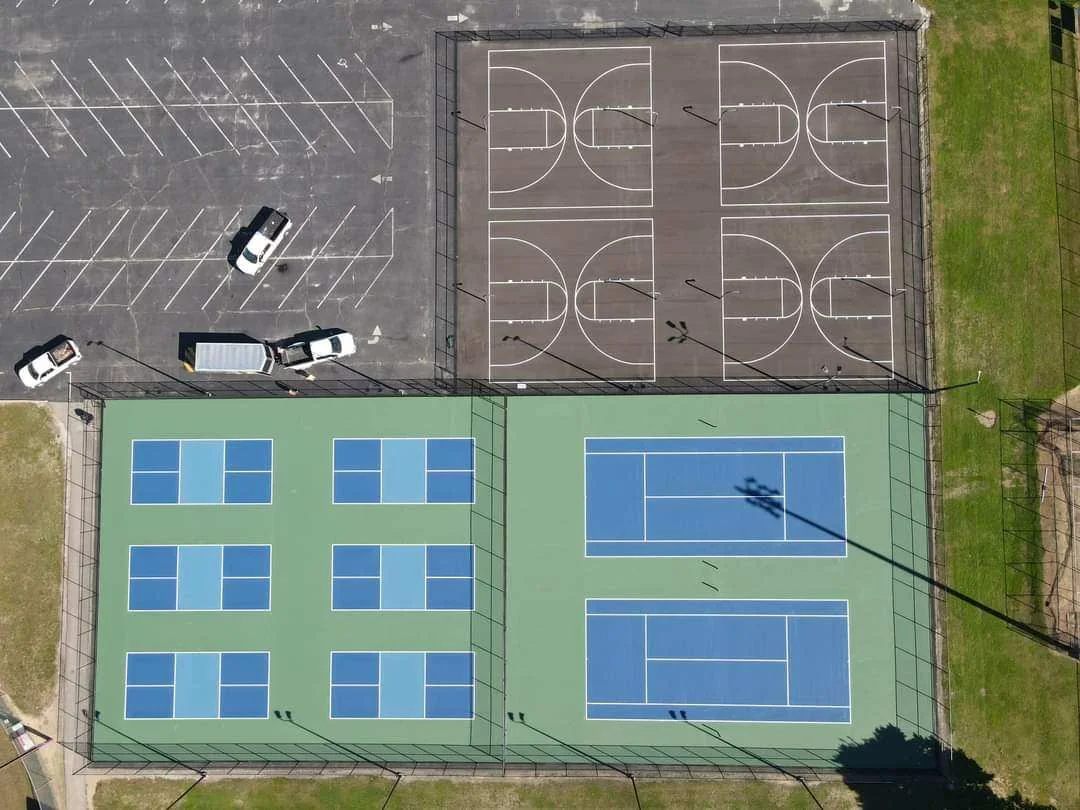
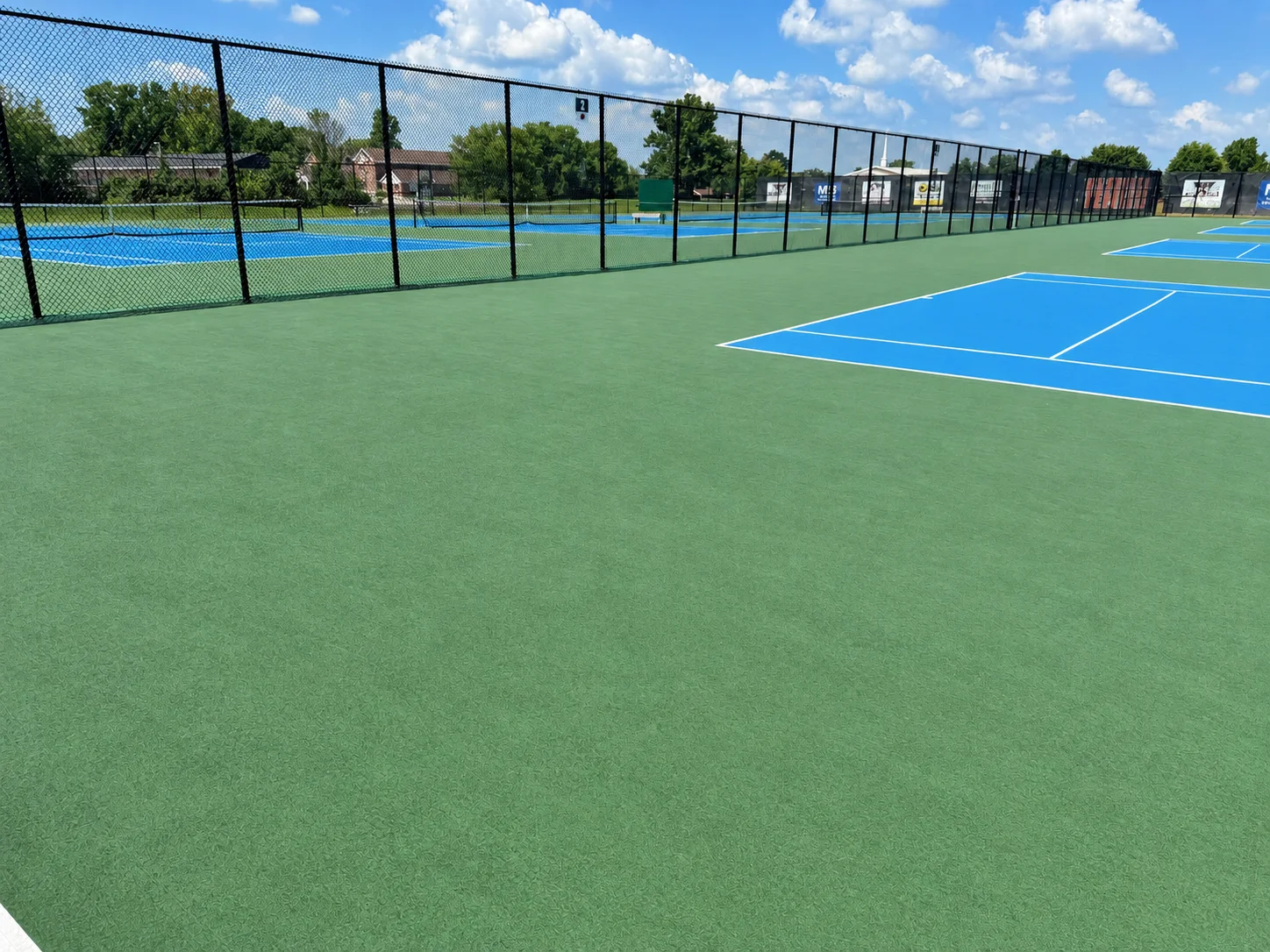
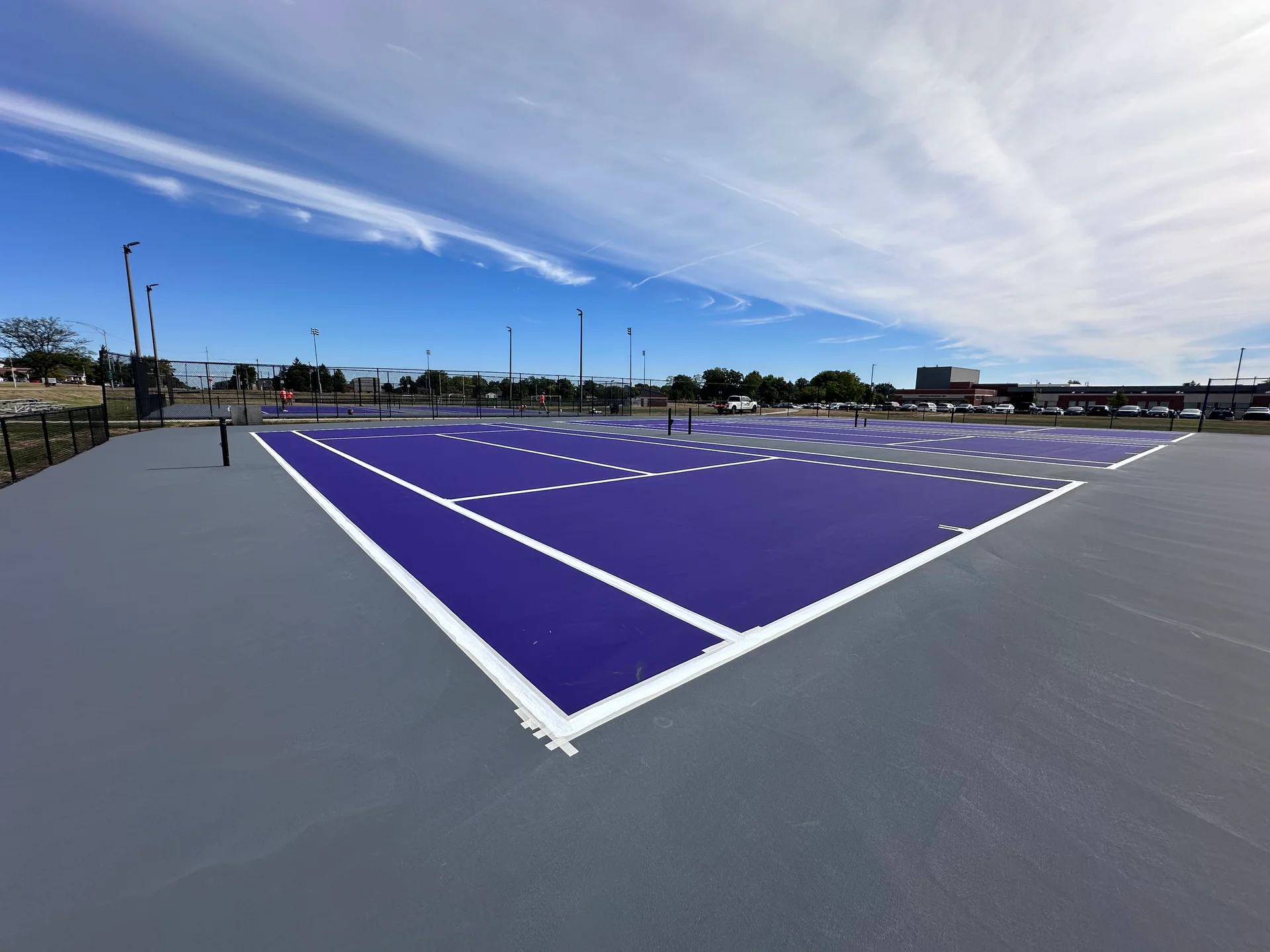
New black chain-link fencing enclosing the resurfaced Fairfield courts
Athletic FacilitiesSouthwest OhioCincinnatiTOP-C purple wordmark logo for The Ohio Purchasing Council cooperative purchasing program

Fairfield Tennis Court Resurfacing 2026

Fairfield Senior High School has eight rebuilt tennis courts: new asphalt over a crack-bridging membrane, a six-coat acrylic surface in two colors, new net posts set in new concrete, and ten-foot black vinyl-coated fence with three gates. Prodigy fixed the cause before the surface, installing underdrains between the courts and a 360-foot swale that keeps runoff off the pavement, and carried the design and permitting for Fairfield City School District. The district bought the project pre-bid through the TOP-C cooperative contract.

Fairfield City School District had eight tennis courts at Fairfield Senior High School with a water problem before it had a surface problem. Runoff entered the courts from the south and east, the asphalt had cracked along roughly 1,100 linear feet, and cracks like that come back through a color coat within a season. Paint was never going to be the answer, and a full reconstruction would have been priced against pavement that was still sound.

So the drainage was dealt with first and the playing surface second. Three rows of underdrain went in between the courts, ground eighteen inches down and built back up with geotextile fabric, washed #57 gravel and four-inch perforated pipe daylighting to the north. A 360-foot swale was cut along the uphill sides to intercept surface water before it ever reached the pavement. Only then did the courts get their cracks bridged with a stress-absorbing membrane interlayer, a half-inch leveling course and an inch-and-a-half ODOT Type 1 surface overlay.

What the district gets back is eight courts inside new ten-foot black vinyl-dipped fence with three gates, finished in a six-coat acrylic system — rust inhibitor over the new pavement, two coats of resurfacer, three coats of color in two colors, and white tennis lines. An amendment during the job added new below-grade net structures, so the posts sit in new concrete and new sleeves rather than the old footings, with new nets and center tie-downs. The work was bought pre-bid on a TOP-C unit price contract, with substantial completion set for mid-August 2026 and the district's own design and permitting carried by Prodigy.

Finished courts with net posts and a gravel drainage border along the edge of the complex
Close view of a red court surface meeting the surround, with new white boundary line
Crew squeegeeing acrylic color coat across the court surface at Fairfield

Technical Discussion

A court has to drain and still play flat

Two requirements govern a tennis court and they pull against each other. The surface has to shed water fast enough that play resumes soon after rain, which takes pitch. It also has to be planar enough that a ball bounces true and nothing stands on it, which punishes pitch — every change in slope is somewhere a ball goes where the player did not expect. Built to drain aggressively, a court plays badly. Built dead flat, it holds birdbaths.

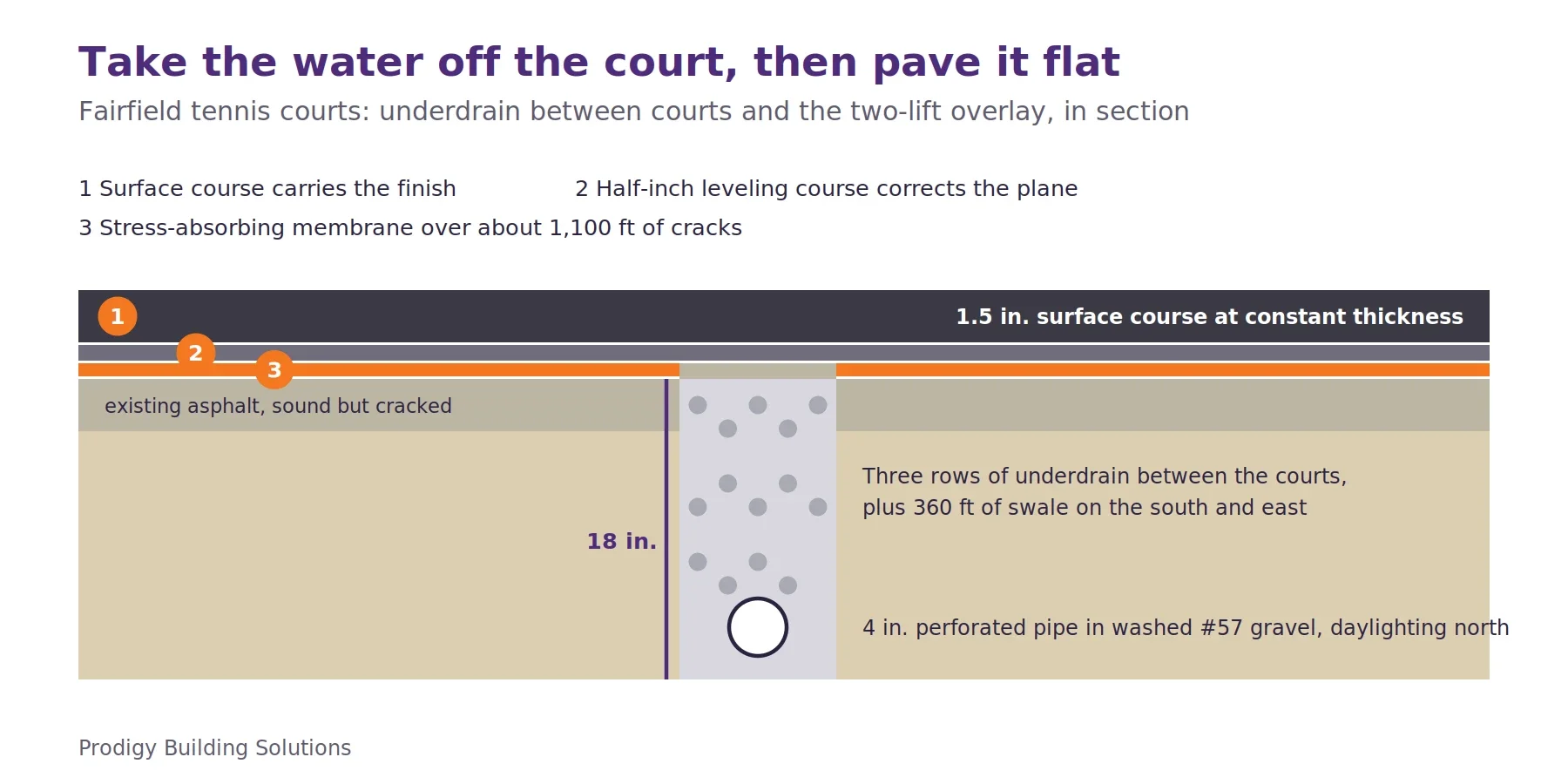
On a resurfacing the plane is inherited. Grinding new slope into eight existing courts means rebuilding them, and these courts did not need rebuilding; the asphalt was sound, it was cracked and it was wet. So the problem was split in two. The water arriving from the south and east — which the courts' own pitch was never sized to carry — was taken off the surface entirely, by 360 feet of swale eighteen inches wide and eighteen deep and three rows of underdrain ground eighteen inches down between the courts, each bedded on washed #57 gravel with four-inch perforated pipe daylighting north. That leaves the surface responsible only for the rain that lands on it, which is what its original pitch was built for.

Flatness then becomes a paving question, and the answer is two lifts rather than one. The half-inch leveling course corrects the plane; the inch-and-a-half surface course goes on at constant thickness so it carries the finish without reintroducing the deviation the leveling course just took out. Under both, a stress-absorbing membrane over roughly 1,100 feet of cracks — on a court an old crack is not only a way in for water, it is a bad bounce waiting to reappear.

Section through the Fairfield tennis court overlay. An underdrain trench 18 inches deep with 4-inch perforated pipe in washed gravel runs between courts. Over the existing asphalt sit a stress-absorbing membrane at the cracks, a half-inch leveling course and a 1.5-inch surface course of constant thickness.
Figure 1 — Drainage is handled below the court so the surface only has to be flat.

Our Work

Similar Projects