How Ohio Schools Choose the Right Commercial Roofing System
EPDM, TPO, PVC, metal, and mod-bit — matched to Ohio's climate, school budgets, and the maintenance crew's Tuesday afternoons.
Most roofing specs are written by engineers who don't work in schools — which is how districts end up paying premiums for systems whose hidden maintenance costs surface years later. This guide walks through how Ohio's extreme freeze-thaw cycling should drive system selection, why two "30-year warranties" can differ by six figures in upkeep, and how EPDM, TPO, PVC, standing seam metal, and modified bitumen each earn their place — section by section, not one-size-fits-all.
How Ohio Schools Choose the Right Commercial Roofing System
When a school district replaces a roof, the decision usually starts with a spec — and the spec usually starts with a template. An engineer pulls a boilerplate commercial roofing specification, adjusts the square footage, and sends it out. The problem is that most engineers spend their careers on offices, warehouses, and retail — not on schools. And a school roof is a different animal: it has to survive Ohio's punishing freeze-thaw climate, outlast multiple superintendents, tolerate a kitchen exhaust fan, and be maintainable by a district facilities crew with a hundred other responsibilities.
Prodigy has spent years helping Ohio schools and government agencies make exactly this decision, and we'll tell you upfront what the rest of this article explains: there is no single best roofing system. There's a best system for each section of each building — and knowing how to match them is worth more than any product brochure.
Start With the Climate, Because Ohio Is Hard on Roofs
Ohio roofs endure some of the widest temperature swings in the country — from below-zero January nights to rooftop surface temperatures above 130°F on a July afternoon. More punishing than the extremes is the frequency of change: our climate crosses the freezing line dozens of times each winter, and a dark roof surface can swing 60 degrees or more in a single spring day.
Every one of those swings makes the roof physically move. Membranes, flashings, and seams expand and contract, over and over, thousands of cycles across a roof's life. Systems that stay flexible and elastic through those cycles age gracefully here; systems that gradually stiffen develop cracks at exactly the points — seams, penetrations, flashings — where roofs actually fail. This single fact, thermal cycling endurance, explains most of what we're about to tell you about which systems earn their keep in Ohio.
The Boilerplate Spec Problem
Here's a pattern we see repeatedly. A district tells its engineer, "We want a roof that lasts a really long time." The engineer, hearing durability, reaches for modified bitumen — a genuinely tough, multi-layer asphalt system with a reputation for ruggedness. The spec goes out, the bids come in, and the district pays a very large premium for that toughness.
What the boilerplate didn't mention: mod-bit's longevity is conditional. To keep performing — and often to keep its warranty — a modified bitumen roof needs periodic maintenance coatings, and those recoating cycles are real money, on a recurring schedule, for decades. The district asked for a long-lasting roof and got one; nobody mentioned it came with a subscription.
This isn't an argument that mod-bit is bad — it has a legitimate home, which we'll get to. It's an argument that specs written for the general market aren't optimized for how schools actually operate: long ownership horizons, lean maintenance budgets, and in-house crews who need to be able to respond to problems between contractor visits.
The Warranty Trap
The other shortcut districts reach for is normalizing systems by warranty: "Get me three prices on a 30-year watertight warranty and we'll compare." In principle, we agree — a 30-year no-dollar-limit warranty is a genuinely useful way to put bids on common footing. But treat it as a starting point, not the whole analysis, because warranties differ in ways the cover page doesn't show:
Wind speed limits. Warranties specify a maximum covered wind speed, and they vary meaningfully. A warranty that excludes damage above a modest gust threshold covers less of an Ohio spring than one rated higher.
Exclusions and conditions. Ponding water, unauthorized rooftop penetrations (the HVAC contractor who screwed a new unit through your membrane), and third-party trades on the roof are common exclusions — and common realities on a school roof.
Maintenance requirements . Nearly every warranty requires documented maintenance to stay valid, but what that maintenance costs varies enormously by system. An EPDM warranty's requirements are often as simple as regular documented roof walks and housekeeping. A mod-bit warranty can require those recurring coatings and professional repairs. Two "30-year warranties" can differ by six figures in what it costs to keep them alive.
Life beyond the paper. Finally, ask what the system does after the warranty expires. A membrane that routinely outlives its warranty by a decade is worth more than one that's tired the year the coverage ends — and that difference never appears in a bid comparison.
The Systems
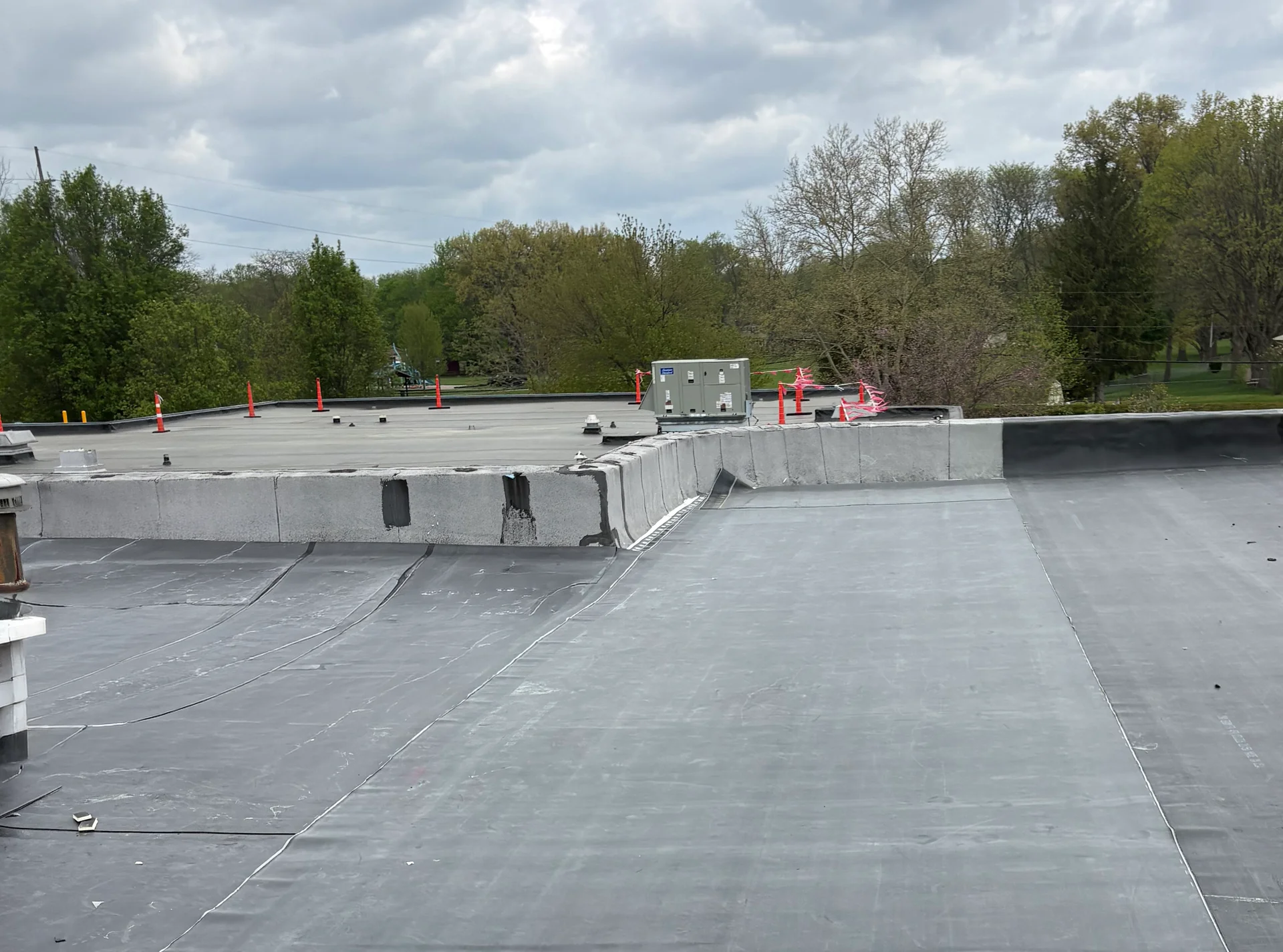
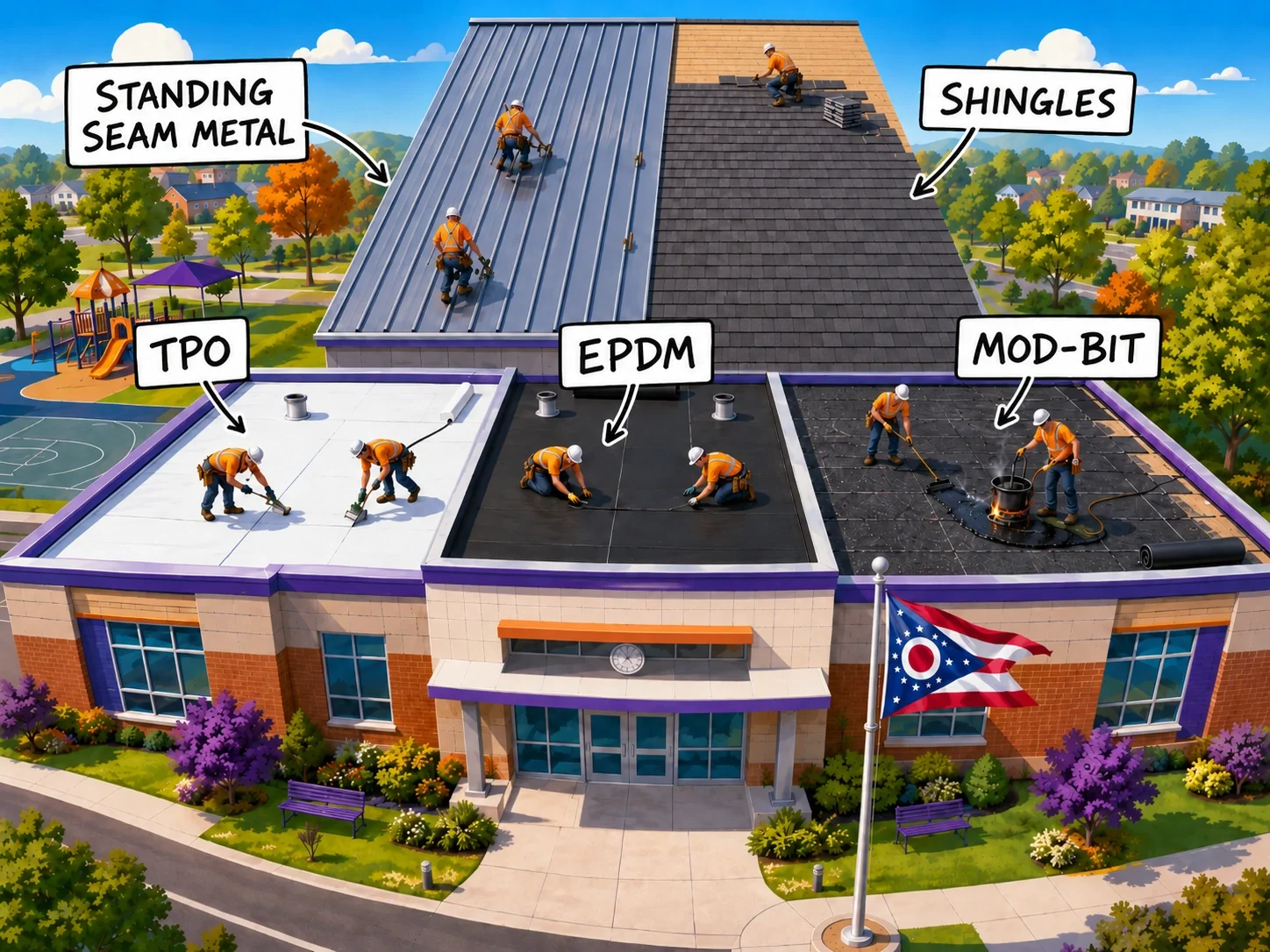
EPDM — our primary recommendation, and the best value in Ohio. EPDM is a synthetic rubber membrane, and rubber is exactly what Ohio's thermal cycling calls for: it stretches and relaxes through decades of expansion and contraction without stiffening the way other chemistries can. In our field experience across Ohio schools and government buildings, EPDM simply lasts here — routinely delivering service lives that make it the best bang for the buck in this market.
Two school-specific advantages seal it. First, warranty upkeep is about as simple as it gets — typically regular documented roof walks rather than costly recurring treatments. Second, and underrated: your own maintenance staff can repair it. An EPDM patch is a clean, primer-and-patch job a capable in-house crew can perform on a Tuesday afternoon. That matters more than it sounds — a small membrane cut fixed same-day is a non-event; the same cut waiting two weeks for a contractor visit through three rainstorms is a ceiling stain in a classroom.
The honest tradeoff: standard EPDM is black, which absorbs heat. In a cooling-dominated southern climate that's a real penalty; in Ohio — a heating-dominated climate where school buildings run their heaviest occupancy September through May — it's a modest factor, and white EPDM and ballasted options exist where reflectivity matters.
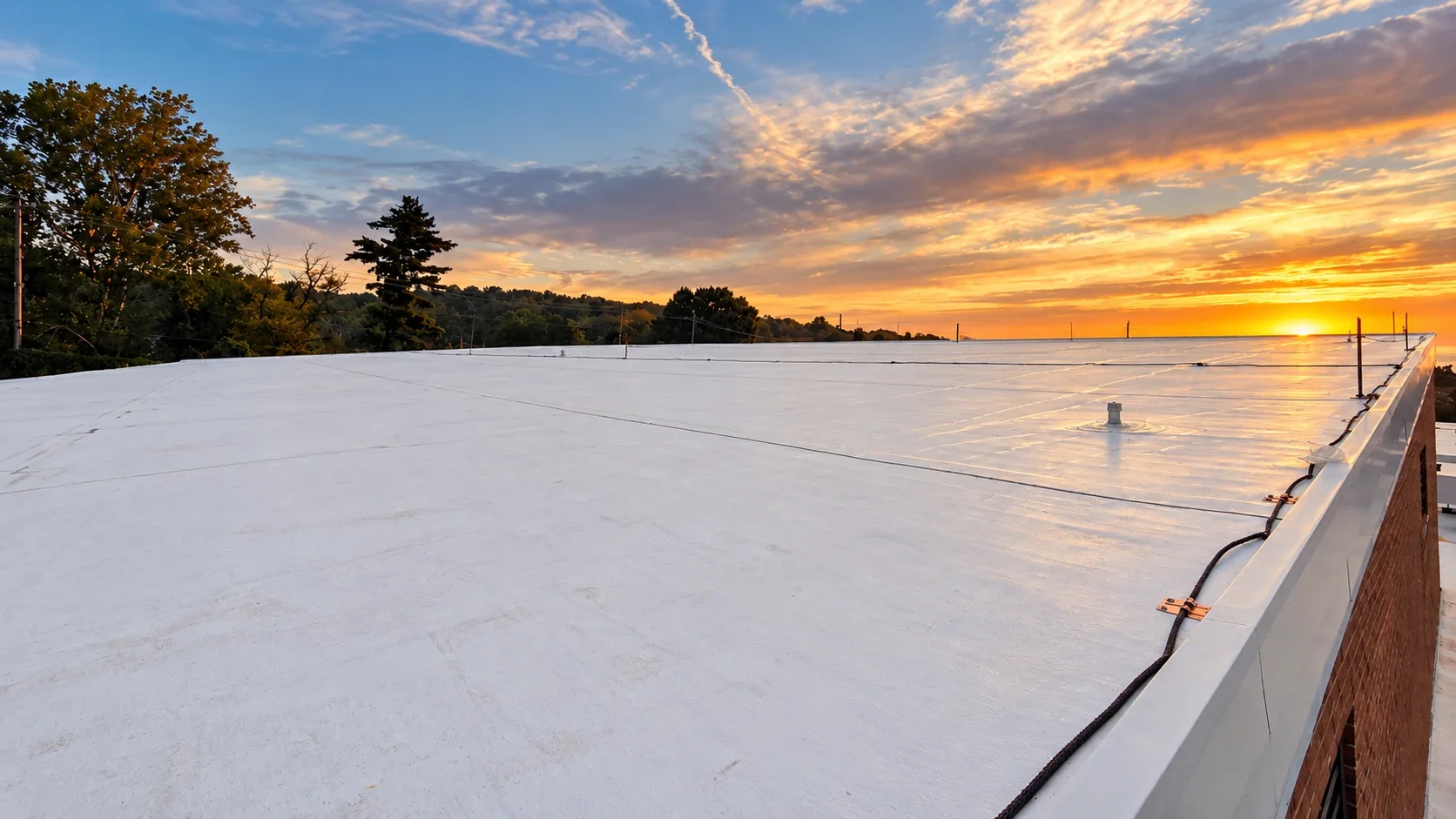
TPO — the value play with strong warranties. TPO is a white, heat-welded single-ply membrane, and it earns its popularity: it's typically the lowest-cost quality system, its reflectivity helps summer cooling loads, and manufacturers back it with robust warranty programs — which makes it a legitimate answer when a project must fit a tight budget cycle and satisfy a board that wants long paper coverage. Our field observation: in Ohio's cycling climate, EPDM tends to outlast it. TPO also carries a repair caveat districts should understand: its seams and patches are heat-welded, which means repairs require specialty welding equipment and a trained technician. Your in-house crew can't patch it the way they can EPDM. We often hear that white roofs have lower cooling costs, but in Ohio, especially in schools in Ohio where occupancy is higher in the winter, it really doesn't have a practical difference on energy costs.
PVC — the specialist. PVC is also heat-welded and costs more than TPO, but it has a superpower no other membrane matches: chemical and grease resistance. Animal fats and cooking oils actively degrade other membranes — and every school has a section of roof sitting above the kitchen's deep-fryer exhaust. That section is a PVC section. Science wing chemical vents, same logic. This is the clearest example of the section-by-section principle: PVC everywhere is an unnecessary premium; PVC above the kitchen is cheap insurance.
Standing seam metal — for the roofs people see. Where a school has sloped roofs — gym barrels, entry canopies, front-facing classroom wings — standing seam metal is excellent: service lives of 40+ years, minimal upkeep, and an appearance a district can be proud of on the building's public face. Its concealed-fastener design accommodates thermal movement by letting panels float, which is why it endures our climate so well. The tradeoffs are upfront cost and the fact that repairs belong to a metal trade contractor — though it needs them rarely.
Shingles — the small-building answer. For steep-slope sections and smaller ancillary buildings — maintenance structures, press boxes, concession buildings — architectural shingles remain the sensible, economical choice. No district needs a commercial membrane on a pitched storage building.
Modified bitumen — tough, with a subscription. And back to mod-bit, in its proper place: it's a genuinely rugged, multi-layer system whose walking surface tolerates heavy foot traffic better than single-ply membranes — a fair consideration for roof sections crews cross constantly to service equipment. But go in with open eyes: it carries a large cost premium, its warranties typically demand the recurring coatings and professional upkeep discussed above, and its installation history includes a hazard worth naming plainly — hot-asphalt and torch-applied installation methods have been known to start building fires during application. Modern cold-applied methods exist, but the combination of premium price, coating subscription, and installation risk is why mod-bit is an occasional, situational choice for us rather than a default.
The Tuesday Afternoon Test
If one question cuts through the brochures, it's this: when a maintenance tech finds a two-inch cut in the membrane on a Tuesday afternoon, what happens next?
On EPDM: your crew cleans, primes, and patches it that day. On TPO or PVC: someone schedules a contractor with a heat welder. On metal: you call the metal trades. On mod-bit: professional repair, and check whether the coating schedule is current while you're at it.
None of those answers is disqualifying — but a district should choose them deliberately, because over a 30-year roof life, the sum of all the Tuesday afternoons is a real number that never appears in any bid.
How to Compare Bids Apples-to-Apples
When roofing proposals hit your desk, five questions put them on common footing: What is the system's expected life in this climate, separate from the warranty term? What does the warranty require annually to stay valid, and what does that cost? What are the wind limits and exclusions? Who can perform repairs, with what equipment? And is the roof being treated as one uniform surface, or matched section by section to what each section faces?
That last question is often the tell. A campus is not one roof — it's a flat main field, a kitchen exhaust zone, a sloped public face, and a heavily trafficked mechanical section. The best proposals treat it that way.
Frequently Asked Questions
Is EPDM or TPO better for Ohio schools?
For most main flat-roof areas, our field experience favors EPDM: longer observed life through Ohio's thermal cycling, simpler warranty upkeep, and in-house repairability. TPO is the right answer when budget pressure is decisive and strong warranty paper is required — it's a good system; EPDM just tends to outlast it here.
How long does an EPDM roof last in Ohio?
Properly installed and maintained, EPDM routinely outlives its warranty term — service lives beyond 30 years are common. The membrane's rubber chemistry handles freeze-thaw cycling better than most alternatives, which is precisely what Ohio demands.
What voids a school roof warranty?
The usual culprits: undocumented maintenance, unauthorized penetrations (often another contractor's equipment install), ponding from clogged drains, and repairs by unapproved methods. The fix is procedural — a simple documented inspection routine and a rule that no one penetrates the roof without the roofing contractor involved.
Can our maintenance staff repair our roof themselves?
On EPDM, generally yes for minor patches — it's one of the system's underrated advantages. On TPO and PVC, no: heat-welded repairs require specialty equipment and training. Whatever system you choose, confirm your warranty's terms for who may perform repairs before anyone does.
Should the whole campus be one roofing system?
Usually not. Matching systems section by section — EPDM on the main field, PVC over kitchen exhaust, standing seam on sloped public faces — costs little in complexity and pays back in performance. Single-system-everywhere is a convenience for the spec writer, not the district.
The Bottom Line
The best roof for an Ohio school isn't a product — it's a set of matches: rubber where the climate cycles hardest, chemical resistance where the fryer vents, metal where the public looks, toughness where the crews walk. Getting those matches right takes people who know both the systems and the buildings — which is exactly the gap boilerplate specs leave open.
Prodigy designs, installs, and maintains school and government roofing across Ohio — with in-house crews, direct material purchasing, and cooperative purchasing eligibility that lets districts procure without a lengthy bid process. See our completed projects, or schedule a consultation and we'll walk your actual roof sections with you.
Our Work