•••
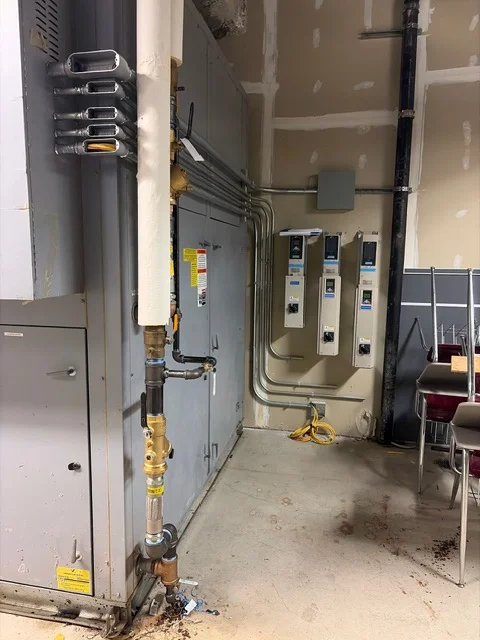
Three new variable frequency drives on the wall beside a heat recovery unit and its insulated piping at Cooper High School
HVAC

Cooper High School HVAC Controls and Drives Upgrade 2026

Cooper High School in Union, Kentucky started the 2026–27 school year with new controls across the heat recovery units that bring fresh air into the building: new DDC controls and safeties on all eight units, 24 new variable frequency drives, new hydronic control valves, and demand-controlled ventilation that sets the outdoor air by how many people are in the room. Prodigy delivered the project for Boone County Schools as the prime contractor on a competitively bid public contract, coordinating the controls, mechanical, electrical and air balancing trades. Much of the work was done on second shift and on weekends while the school was in session, with temporary heating and cooling brought in whenever a unit had to be taken off line, and the project reached completion in August 2026.

A heat recovery unit is the part of a school's HVAC that decides how much outdoor air comes in, and every cubic foot of it has to be heated or cooled before it reaches a classroom. The design for Boone County Schools, by the engineering firm Shrout Tate Wilson, put all eight units on new controls and one family of drives, and tied four of them to the building's actual occupancy.

Each unit now has a new three-way hot-water control valve, new refrigerant pressure transducers and temperature sensors, hardwired high- and low-pressure safeties, control of its enthalpy wheel, and a low discharge-air shutdown that protects the coils in winter. The 24 Yaskawa drives range from three-quarter horsepower on the enthalpy wheels to 25 horsepower on the largest fans, and every fan drive is packaged with a bypass so a drive fault does not take a unit down. The independent air balancer used the drives to set each fan's airflow, and took readings before and after the work. On four of the units, outdoor air now modulates with the carbon dioxide measured in the spaces they serve.

The result is a high school whose fresh-air units run from one set of controls, can be balanced and adjusted from a drive keypad or the building automation system instead of by changing belts and pulleys, and bring in outdoor air in proportion to the people in the building. For a district looking at older air handling equipment, it is a reminder that a controls and drives project can change how a building runs without replacing the units themselves.
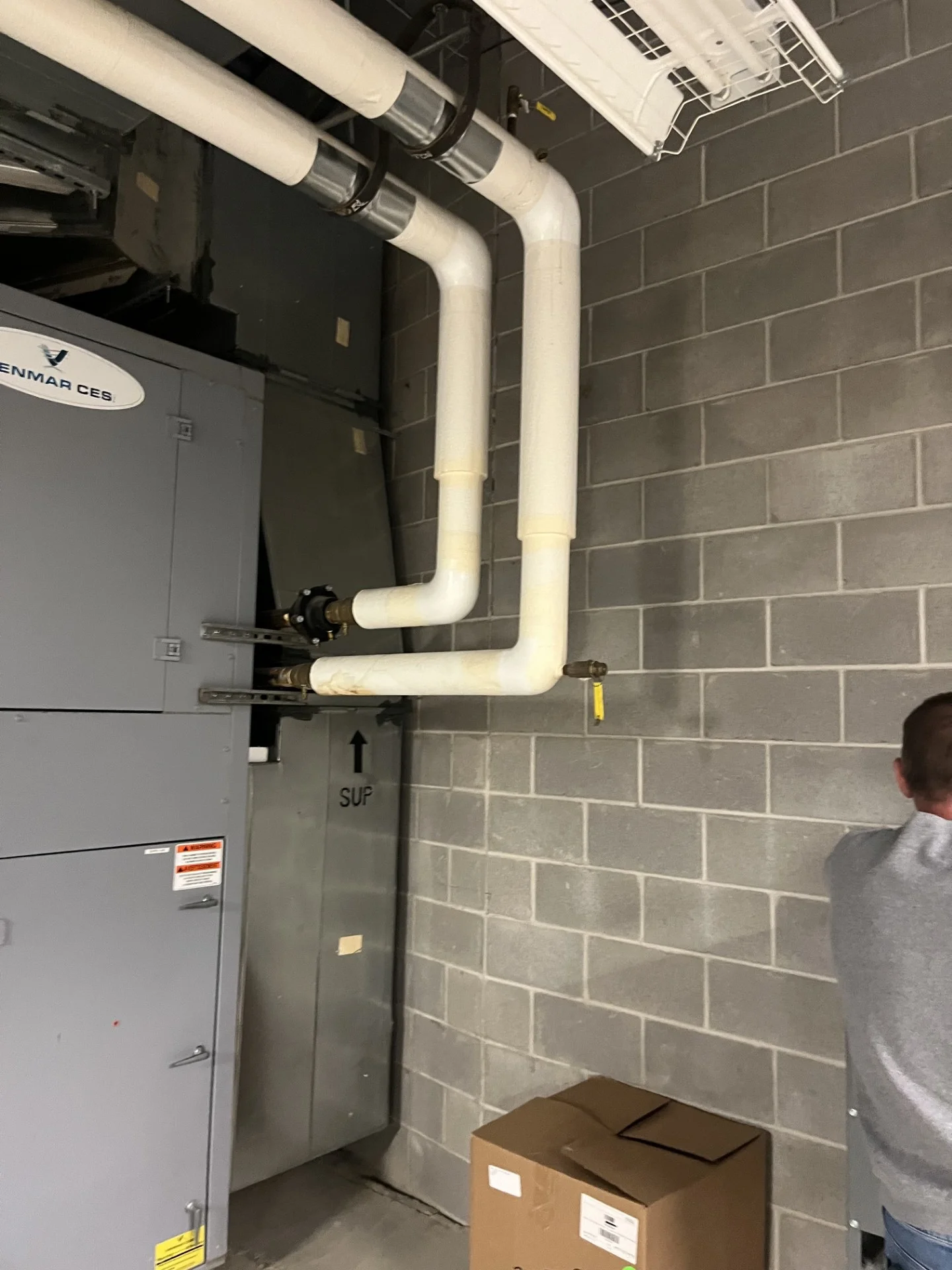
Heat recovery unit with new insulated hydronic piping in a Cooper High School mechanical room
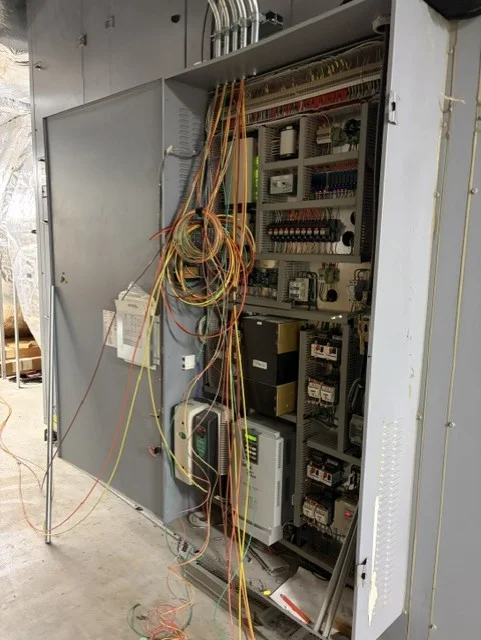
Heat recovery unit control panel opened during rewiring, with new drives and controls wiring inside
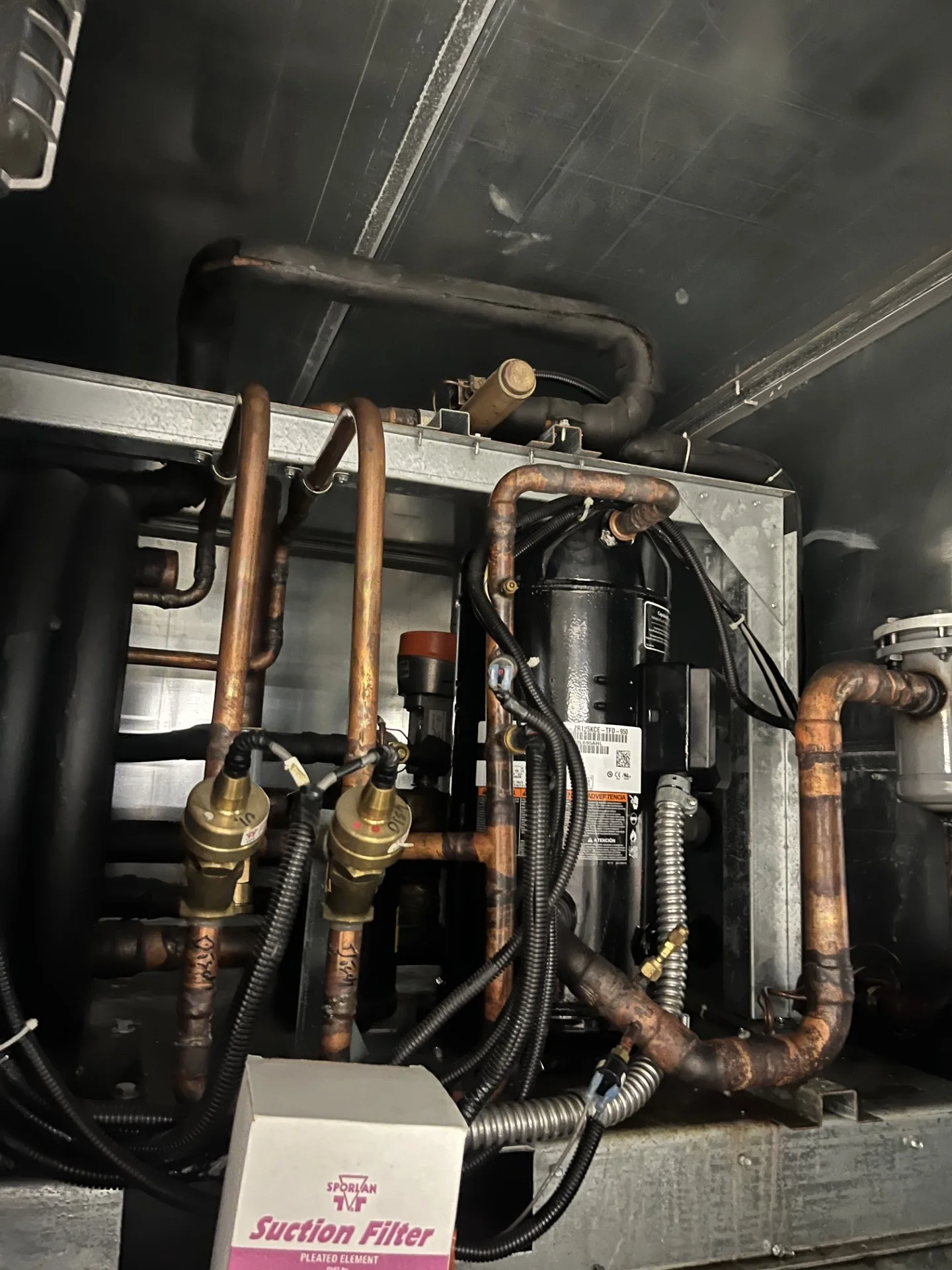
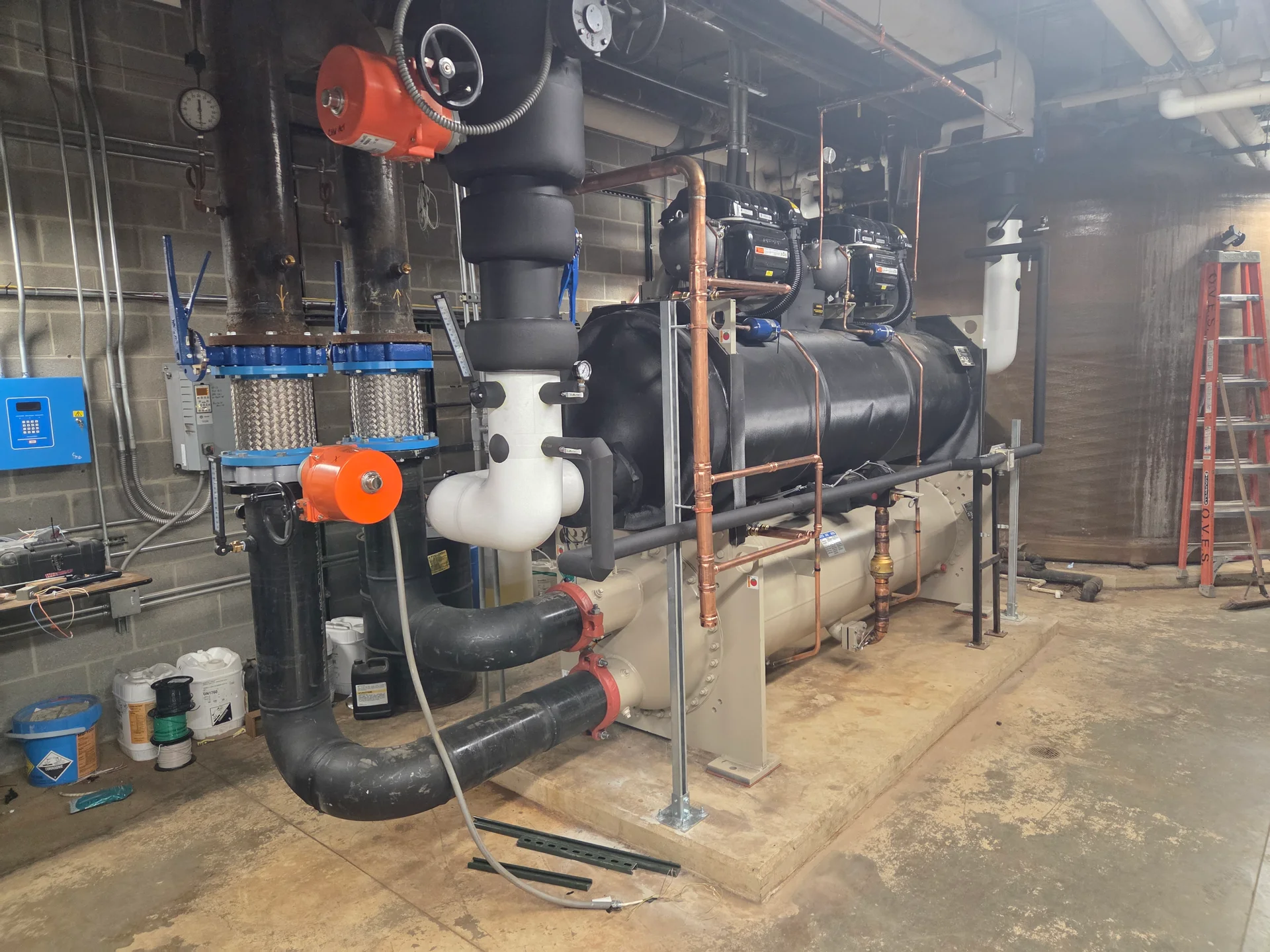
Compressor and copper refrigerant piping inside a heat recovery unit during the Cooper High School controls work

Technical Discussion

Ventilating by headcount: CO2 control on the heat recovery units

Outdoor air is the most expensive air a school moves. Every cubic foot has to be heated in January and cooled and dried in August before it reaches a classroom, and an enthalpy wheel recovers part of that energy but not all of it. The conventional way to set outdoor air is to size it for a full building and hold the damper there all day. The design for Cooper High School went the other way on four of its heat recovery units, and set the outdoor air by measuring the people in the rooms.

How the sequence works

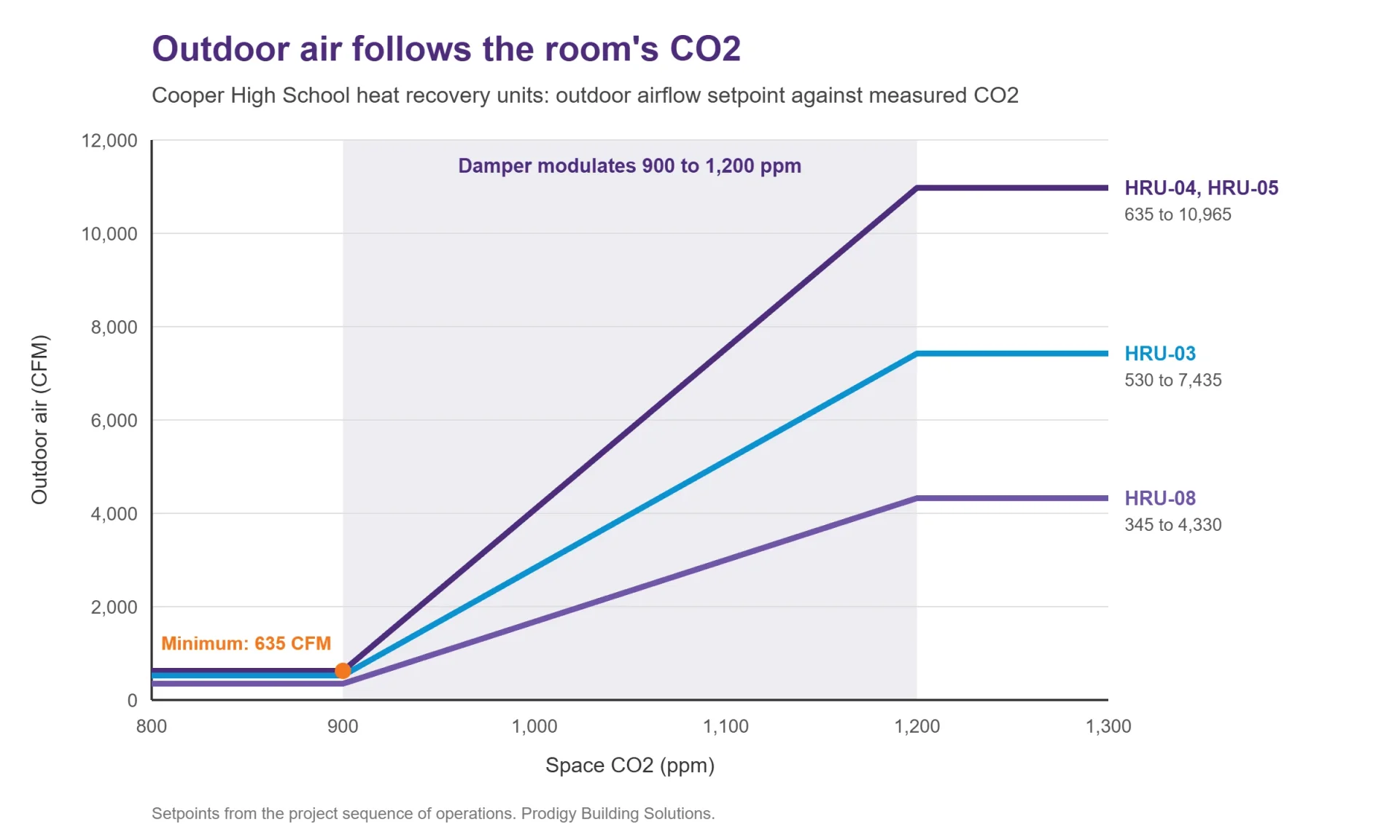
People exhale carbon dioxide, so the CO2 level in an occupied space rises with the number of people in it and falls as fresh air dilutes it. Outdoor air sits at about 400 ppm. On HRU-03, HRU-04, HRU-05 and HRU-08, the outdoor-air damper holds at its minimum until the space reaches 900 ppm, then opens in proportion until it reaches its maximum at 1,200 ppm. The exhaust damper tracks the outdoor-air damper at a 10 percent offset, so the building is kept slightly positive and does not pull unconditioned air in through doors and gaps.

Line chart of outdoor airflow against space CO2 for Cooper High School's heat recovery units. Each line holds at its minimum below 900 ppm, rises steadily through a shaded band from 900 to 1,200 ppm, and levels off at its maximum: HRU-04 and HRU-05 from 635 to 10,965 CFM, HRU-03 from 530 to 7,435 CFM, and HRU-08 from 345 to 4,330 CFM.
Outdoor air on four of Cooper High School's heat recovery units ramps from minimum to maximum as space CO2 rises from 900 to 1,200 ppm.

The size of the swing

The minimums and maximums show what is at stake. HRU-04 and HRU-05 each run from 635 to 10,965 CFM of outdoor air, HRU-03 from 530 to 7,435, and HRU-08 from 345 to 4,330. Across the four units that is a range from 2,145 CFM to 33,695 CFM. At the minimum, the units bring in about 6 percent of their design outdoor air. A damper fixed for a full building would hold near the top of that range whenever the school was open, whether the rooms held a full class change or a handful of people after the last bell.

Protecting the coils when the damper is wide open

The sequence has a second job. When CO2 drives a damper toward its maximum on a cold morning, far more outdoor air crosses the coil. Each unit now carries a low discharge-air shutdown at 45°F (adjustable) and hardwired high- and low-pressure safeties, so a unit that cannot keep up stops before it freezes a coil or damages a compressor. Demand control only saves energy if it is safe to let the damper open, and the safeties are what make that true.

The amount of outdoor air a school needs changes by the hour. A fixed damper is sized for the worst hour of the year and runs that way all year; a CO2 sequence spends the energy only when the rooms are full.