Three Bids, One Price: How the “Basis of Design” Quietly Narrows Competition on School HVAC Projects
Public owners see three sealed bids and reasonably assume the market has spoken. But on most plan-and-spec projects, the single largest line, the specified equipment, was decided before pricing ever existed, and it rides through all three bids untouched. Prodigy's in-house engineers put the application out to competing manufacturers, buy the equipment directly, and bid the labor on its own, so every dollar in the budget number is actually competed.
Prodigy's Process Improves Public Procurement
The Traditional Procurement Process
Ask a school business manager whether their last capital improvement project was competitively bid with an A&E firm and the answer is almost always yes. Three general contractors submitted sealed bids. The board awarded to the lowest responsible bidder, exactly as Ohio law requires. The market spoke.
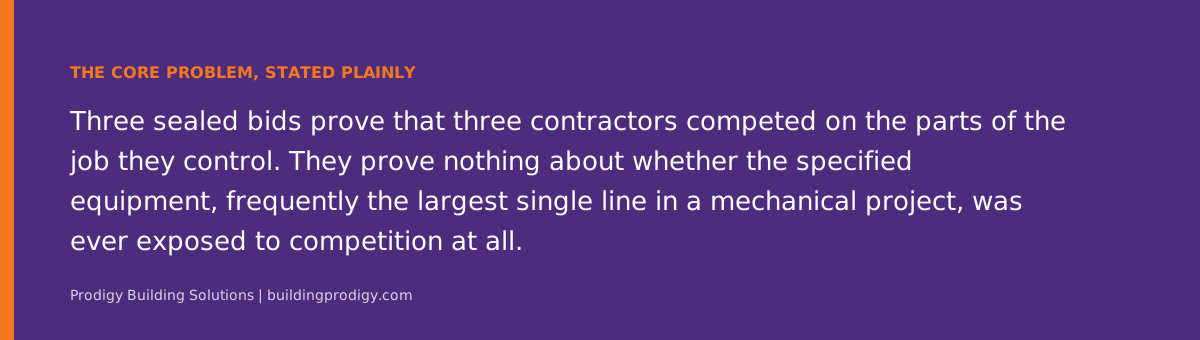
Look one layer deeper and the picture changes. The three contractors competed hard on their overhead, their labor, and their subcontractor prices. But the rooftop units, the boilers, or the chillers in all three bids very likely came from the same manufacturer, through the same distributor, at a price that nobody in the process ever had the leverage to negotiate. The equipment package, often the single largest line in a mechanical project, was decided months earlier, on a page of the specifications most owners never read.
This post explains how that happens, why it is not anyone’s fault, what it costs, and how Prodigy Building Solutions engineers around it.
How a product gets into the specification
Every set of construction documents has to tell bidders what to price. For engineered equipment, the specifier names a “basis of design”: a specific manufacturer and model whose performance defines the standard, followed by language like “or approved equal.” Specification writers describe basis of design plainly as another way of saying “this product, or equal.”
The interesting question is how a particular product earns that spot. The American Institute of Architects has surveyed its members on this for years. In its 2020 “Architect’s Journey to Specification” study, architects reported that manufacturer websites and general internet research were the sources they consulted most often, but when asked which source had the greatest influence on what they actually specified, continuing education ranked first. [1] The 2023 edition found that 83 percent of architects rely on continuing education and webinars as their most widely used source for staying current on products, and that more than 80 percent are responsible for identifying new products for their projects. [2]
Who provides most of that continuing education? Manufacturers. This is not a secret; the firms that market CE courses to building-product companies say it outright: “education equals specification.”
So the chain begins innocently. A manufacturer’s representative delivers a well-produced lunch-and-learn. The engineer earns required CE credit and comes away with a product he understands, complete with a ready-to-paste specification section. On the next project, that product becomes the basis of design. Everyone did their job.
Open, closed, and sole-source: three degrees of lock-in
The Construction Specifications Institute distinguishes three flavors of proprietary specifying. An open proprietary spec names several acceptable manufacturers. A closed proprietary spec limits the options to one or two. A sole-source spec names one product with no substitutions. [3] Consulting-Specifying Engineer summarizes the trade-off from the engineer’s side: a closed specification gives the engineer and owner complete product control and reduces review time, but it “limits competitive bidding, potentially raising costs,” can extend lead times, and restricts the installer pool to those certified on that system. [4]
Here is the subtle part. An “or equal” clause looks like an open door, but whether it functions as one depends entirely on how Division 01 of the specification defines the criteria for a substitution and how much appetite the designer has to review one. When substitutions are effectively not permitted, “the specified manufacturer faces no competitive pressure on that particular project.” [5] Public-contracting attorneys make the same point from the legal side: inserting “or equal” does not cure a sole-source specification if, in practice, only one vendor can meet the listed requirements. [8]
In other words, the specification can read as competitive while behaving as closed. Nobody has to intend that outcome for it to occur.
Following the money through the chain
Now trace the specified product from the drawings to the bid form. On a conventional design-bid-build project the parties look like this:
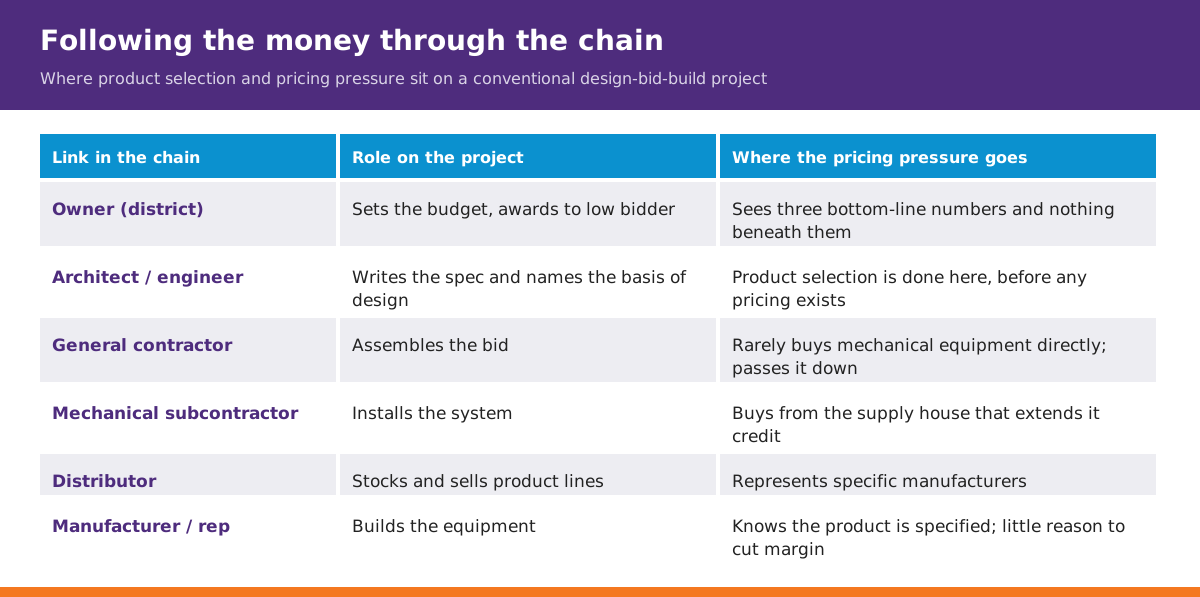
Two features of this chain deserve attention. First, the subcontractor almost never shops the equipment on the open market, and the reason is financing. Construction suppliers routinely extend trade credit, letting a contractor take material now and pay 30 or more days later, which is essentially an interest-free loan in an industry where cash flow failures are a leading cause of business failure. [12] That credit is valuable, and it creates loyalty. A mechanical contractor whose supply house carries $400,000 of his receivables is not going to send that supply house’s competitor an RFQ for the next boiler.
Second, all three general contractors are typically pricing the mechanical scope from the same two or three mechanical subs, who in turn are all quoting the same specified equipment from the same regional distributor. The competition you see at the top of the chain does not reach the bottom.
Why the law cares, and why it usually can’t help
Public-bidding statutes exist precisely to prevent this. Pennsylvania’s public-contracts commentary calls proprietary specifications “inherently suspect and contrary to the spirit of public and competitive bidding,” and documents an HVAC case in which a manufacturer’s representative refused to provide itemized base-equipment pricing, leaving competing bidders unable to price an alternative at all. [7] A construction attorney writing for School Construction News warned public owners that narrowly tailored specifications “more often than not will result in higher pricing to the public owner without necessarily resulting in a better product,” and added a second risk: under the Spearin doctrine an owner warrants the adequacy of its specifications, so a locked-in product that underperforms becomes the owner’s liability, not the designer’s. [6]
Ohio is no different in principle. Boards of education must competitively bid construction above the threshold in ORC 9.17 (currently $75,000, indexed 3 percent annually since Senate Bill 168 took effect in October 2024) and must accept only the lowest responsible bid. [10] [11] The Ohio School Boards Association’s own guidance cautions that “if specifications are too limiting, this may discourage competition, increase costs and, ultimately, be struck down by courts.” [9]
The difficulty is enforcement. A spec that names one product with an “or equal” clause is facially compliant. Unless a competing manufacturer is motivated enough to protest, nobody audits whether the “or equal” was real. The law addresses intent; the cost problem is structural.
A worked example: replacing a school boiler plant
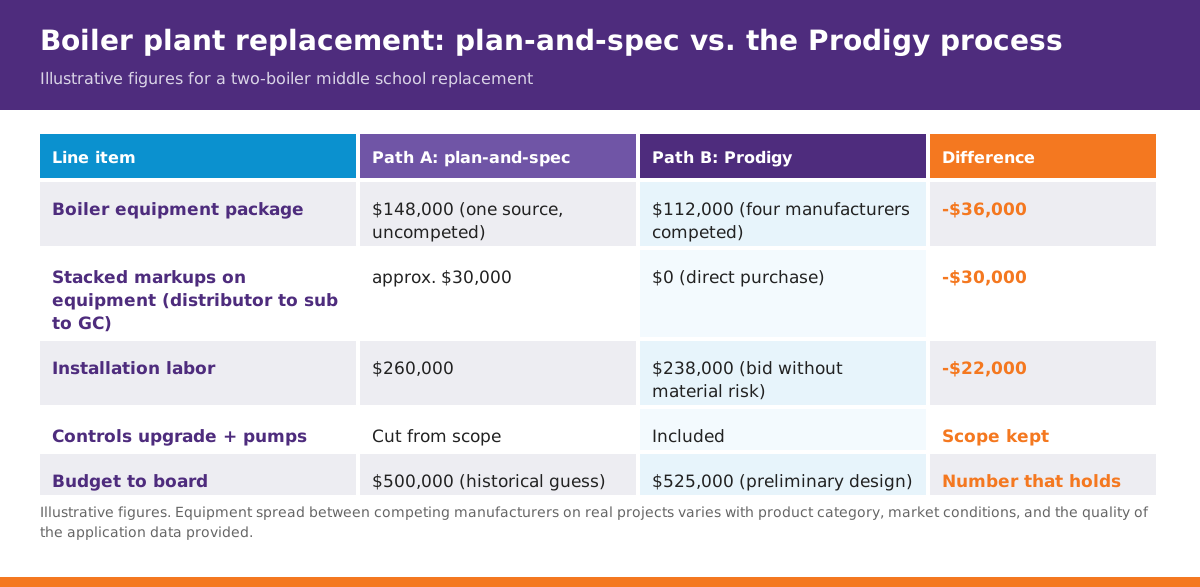
The numbers below are illustrative, constructed to show the mechanism rather than reported from a single project.
Consider a middle school replacing two aging cast-iron boilers with high-efficiency condensing units. The district was given a planning figure of $500,000 two budget cycles ago. The engineer names a basis of design he knows well and specifies it in a closed proprietary format: one manufacturer, two named model numbers, “or approved equal” with a substitution procedure that requires the bidder to submit a full engineering comparison ten days before bid opening.
Path A: conventional plan-and-spec
The regional distributor for the specified manufacturer quotes the two boilers and accessories to every mechanical sub at $148,000. No sub requests an alternate; the ten-day substitution window is not worth the risk on a bid they may not win.
Each of the three mechanical subs adds handling, warranty, and markup; the GCs add their markup; the bids come in at $612,000, $640,000, and $655,000.
The district now has a $612,000 low bid against a $500,000 appropriation. It cuts the controls upgrade, defers the pump replacement, and re-approves the project. The equipment line was never negotiated by anyone.
Path B: the Prodigy process
Before any budget goes to the board, our in-house engineers survey the plant: actual heating load, existing venting and gas capacity, pump and controls condition, and the summer construction window.
We send that application, not a model number, to four boiler manufacturers and ask each for its best system solution with installed footprint, turndown, efficiency curve, warranty, and price. Every one of them knows the others are pricing it.
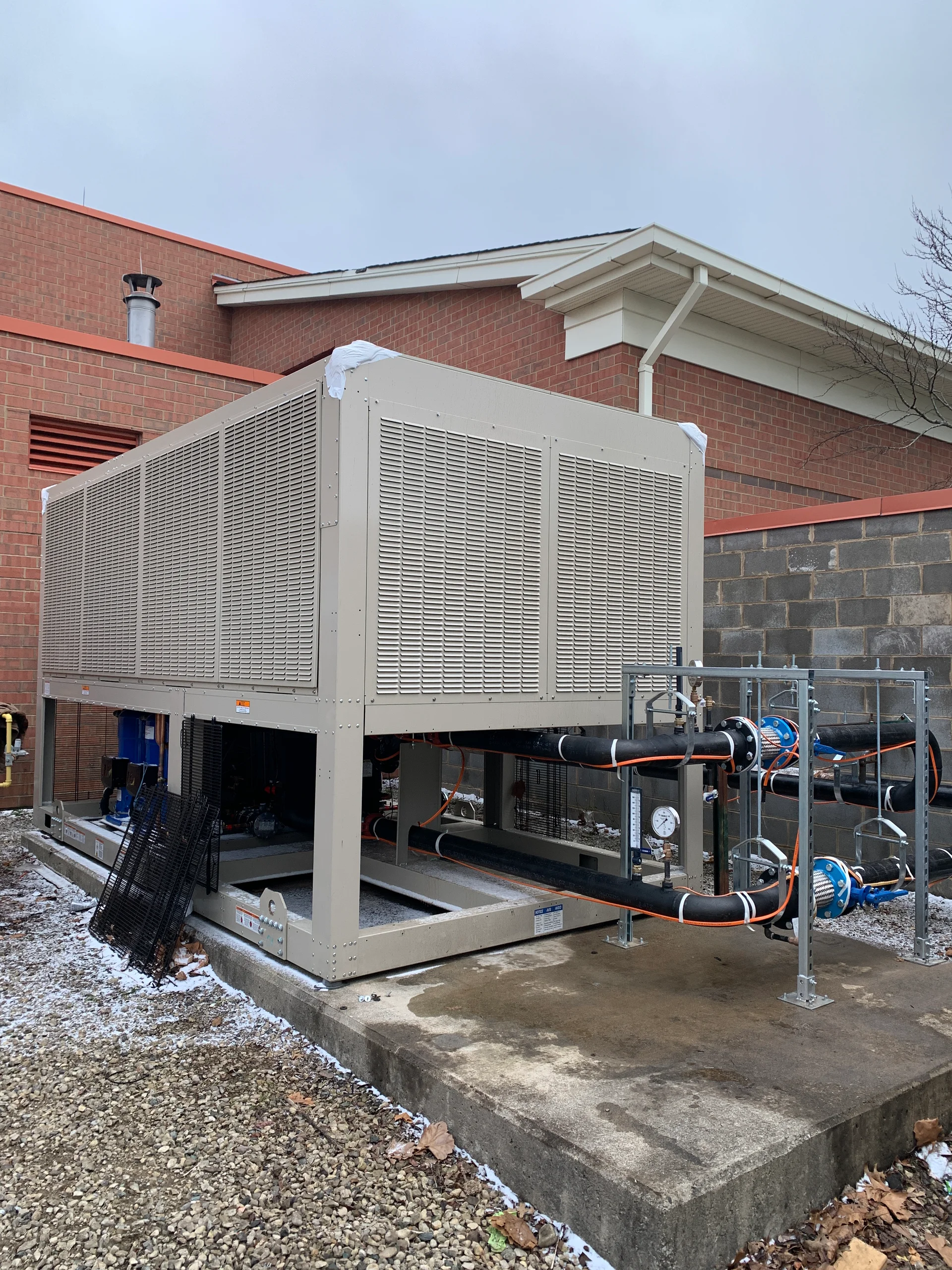
The proposals come back between $101,000 and $131,000 for equivalent capacity. Our engineers evaluate the systems, not the stickers: one lower-priced option needs a third unit and a larger flue, another has a better turndown ratio that will save gas at part load through the shoulder seasons. We select the option with the best installed and operating cost, and we buy it directly.
With the equipment purchased, we competitively bid the labor to mechanical contractors who no longer have to finance the equipment or carry its warranty risk. Labor pricing tightens.
The preliminary design goes to the board with a number that includes the controls upgrade and the pumps. It holds through construction, and the district owns a boiler plant selected for its building rather than for the engineer’s familiarity.
What makes this work at Prodigy
None of the steps in Path B are exotic. What makes them possible is having the right pieces under one roof:
Engineers in the room from day one. Because our mechanical, electrical, and architectural staff are in-house, product selection happens with cost on the table, not after the design is frozen. We evaluate the complete system, including how many units, what venting, what controls, and what the part-load efficiency does to the utility bill.
Vendor-agnostic by policy. We maintain long relationships with manufacturers, but we keep the lines open on every project. We tell several manufacturers the application and let them compete for it. The right answer changes from building to building.
Direct purchasing, paid in cash. Buying major equipment ourselves removes the distributor and subcontractor markups and, just as important, removes the credit relationship that keeps installers from shopping.
Labor bid on its own. Installers price the work they actually want to do, without material financing or warranty exposure. Many prefer it.
A shorter chain after the project. When a unit faults in February, we call the manufacturer or the installing contractor directly instead of routing a warranty question through five companies.
Procurement paths that allow it. Ohio districts can reach this process through cooperative purchasing contracts and other authorized delivery methods that bring design, pricing, and construction together earlier than a conventional low-bid sequence permits.
When the specified product should stay
It would be wrong to suggest every basis of design is a problem. Sometimes the named product is there for a reason: it matches the district’s existing controls platform, its maintenance staff is trained on it, or a specific certification is required. When we evaluate an alternate we compare it on six things, performance, warranty, installation requirements, maintenance, expected life, and total cost, and if the specified product wins, we say so. The goal is not to substitute; it is to understand why the requirement exists and then find out whether the market has been narrowed on purpose or by accident.
The takeaway for district leaders
The next time a project comes in over budget with “three competitive bids,” ask the difficult questions. How many manufactures actually priced equipment? Are the manufacturers carrying all of the equipment or are they buying from other manufactures and passing it through? Are the contractors carrying subcontractors that are carrying lower tiered subcontractors? Was the design specification really engineered for the application or was it copied and pasted from a different job that may have additional requirements tat are not necessary? Often you'll find that bids competed on everything except the thing that cost the most. Prodigy Building Solutions was built to change that answer, by understanding the design, understanding the supply chain, creating real competition on both material and labor, and taking responsibility for the result from the board vote through the last punch-list item.
Where this process came from
Prodigy's founders spent years inside the traditional system before they set out to change it: on the manufacturer and representative side, where the job is to get your product written into the specification, and beside owners who watched approved budgets turn into over-budget bids. They had seen the private sector do this better, with owners controlling their own design, buying material directly, and bidding labor on its own, and they spent years building a legal, audited way to bring those efficiencies to public owners. The result is a model designed to align our interests with the owner's, from the number the board votes on to the last punch-list item.
The best evidence that this works comes from the people who live with it. Jason Nash, Director of Operations for Oak Hills Local School District, put it in writing after several years of projects together, describing specifications written so that no one manufacturer has an advantage and a process that makes his job easier. You can read his letter, and the rest of how Prodigy came to be, at Our Story.
To talk through an upcoming HVAC, roofing, or renovation project, contact Prodigy Building Solutions or explore our cooperative purchasing partners at buildingprodigy.com.
References
[1] AIA, “Sustainability in the Architect’s Journey to Specification 2020” (summarized by Green CE). https://www.greence.com/Product_Manufacturers/Spec_Shaman/AIA-0
[2] AIA, “2023 Architect’s Journey to Specification”. https://www.aia.org/resource-center/2023-architects-journey-specification-reveals-post-pandemic-shifts-firm-culture
[3] Kevin O’Beirne, PE, FCSI, “Proprietary specifying 101: A CSI exclusive,” The Construction Specifier. https://www.constructionspecifier.com/proprietary-specifying-101-a-csi-exclusive/
[4] Michael Heinsdorf, PE, “Closed and open specifications,” Consulting-Specifying Engineer. https://www.csemag.com/closed-and-open-specifications/
[5] ZeroDocs, “Basis of Design and Substitutions Simplified”. https://zerodocs.com/basis-of-design-3-part-specification/
[6] David Bashford, Bradley Arant Boult Cummings, “Public Owners Beware: Overly-Restrictive Specifications,” School Construction News. http://schoolconstructionnews.com/2012/03/01/public-owners-beware-overly-restrictive-specifications/
[7] “Public Bidding 101: Are Proprietary Specifications Permissible?” PA Public Contracts. https://www.papubliccontracts.com/2014/07/10/public-bidding-101-are-proprietary-specifications-permissible/
[8] Smith, Gambrell & Russell, “Are Sole Source Specifications Enforceable?”. https://www.sgrlaw.com/are-sole-source-specifications-enforceable/
[9] Ohio School Boards Association, “Competitive Bidding” fact sheet. https://www.ohioschoolboards.org/sites/default/files/OSBACompetitiveBiddingFactSheet.pdf
[10] Squire Patton Boggs, “Competitive Bidding Threshold Increases for Ohio Public School Districts”. https://www.squirepattonboggs.com/insights/publications/competitive-bidding-threshold-increases-for-ohio-public-school-districts/
[11] Ohio Revised Code § 3313.46. https://codes.ohio.gov/ohio-revised-code/section-3313.46
[12] Procore, “Trade Credit: The Benefits & Risks to Contractors and Suppliers”. https://www.procore.com/library/trade-credit-construction
Our Work