How Cooperative Purchasing Works for Ohio Cities and School Districts
Most Ohio public agencies default to the traditional design-bid-build process — slow, fragmented, and often delivering a building that wasn't designed for how staff actually use it. Cooperative purchasing offers another path: the competitive bidding happens once, up front, at the Council of Governments level, so member cities and school districts can build faster and at lower cost while staying fully compliant. Here's how an agency actually uses it.
For most public agencies in Ohio, construction procurement means the traditional design-bid-build process: write a specification, advertise for bids, wait weeks for the window to close, award to the lowest bidder, and hope the finished building works the way your staff actually needs it to. It's a process built for fairness and transparency — and it delivers those — but it's slow, it splits accountability among a half-dozen parties, and it often produces a building that satisfied a spec sheet without being designed for the people who use it.
Ohio law provides another route. Cooperative purchasing lets a city or school district procure construction through a Council of Governments — faster, at lower cost, with a single accountable partner — while remaining fully compliant with the state's competitive bidding requirements. It isn't a loophole or a workaround; it's a procurement path the Ohio Revised Code specifically authorizes. This article walks through how an agency actually uses it.
What Cooperative Purchasing Is
Cooperative purchasing is, in essence, outsourcing procurement to an organization that specializes in it. Instead of every city and school district separately running its own bid for a roof, an HVAC system, or a building renovation, a Council of Governments (COG) runs one large, competitive bid on behalf of all its members. Vendors are vetted, references are checked, pricing is competitively established — and member agencies can then use those pre-bid contracts directly.
The effect is to align a vendor's interests with the agency's: the COG handles the details of vetting, procurement law, and pricing, and the member gets a better, simpler, lower-cost project. The COGs already exist and already hold competitively bid contracts across most construction trades — so for an agency, the practical question isn't how to build one, it's how to use one.
The Legal Basis
Before the how, the one question every city manager and treasurer asks first: is this compliant? It is, and the basis is worth knowing in case your council or auditor asks.
Ohio's ORC Chapter 167 authorizes political subdivisions — cities, villages, school districts, counties — to join Councils of Governments, and two provisions then let a member procure through the COG without re-running a bid that already happened:
ORC 167.081 is the building-construction track. For the repair, improvement, or construction of a building or structure, a member may use a COG's unit-price contract, and — in the statute's own language — purchases made under such a contract are exempt from any competitive selection or bidding requirements otherwise required by law. In plain terms, purchasing under 167.081 supersedes the standard competitive-bidding requirements (such as ORC 735.05) that would otherwise apply. The public-notice requirement is treated as already satisfied, because the COG met it when it advertised and awarded the contract in the first place.
ORC 9.48 is the broader joint-purchasing track, and it's the applicable path when a cooperative wasn't formed under Chapter 167. The distinction matters when you're choosing which cooperative to use, and it's covered below.
That's the legal foundation in brief. The competition genuinely happened — it just happened once, at the COG level, before you placed your order. Everything that follows is about how you, as an existing or prospective member, put that to work.
How You Actually Use a Coop
Here's the process from the agency's side, start to finish.
1. Pick the project and the cooperative. Most COGs already hold competitively bid contracts across the major trades — roofing, HVAC, paving, renovation. The one thing to confirm up front is that the cooperative fits the law your project runs under. Cooperatives formed under ORC Chapter 167 — such as The Ohio Purchasing Council (TOP-C), Southwest Ohio EPC, Equalis/Gordian, and The Ohio Schools Council — can be used for either ORC 167.081 or ORC 9.48 procurement. Others, such as The Interlocal Purchasing System (TIPS) or the 791 Cooperative, weren't formed under Chapter 167 and can be used only under ORC 9.48. For a building-construction project, that single distinction usually points you to a Chapter 167 COG and the 167.081 track.
2. Select your vendor and design the project together. You work directly with a contractor holding the relevant COG contract, like Prodigy. Rather than handing over a finished spec, you bring the contractor in during design — so functional, cost-effective solutions get built into the project instead of discovered after bids come back. This is the single biggest practical difference from design-bid-build, and it's where most of the quality and cost advantage comes from.
3. Budget it — with room to adjust. The contractor works with you to budget the project against the COG's unit pricing. Here's a critical advantage over a traditional public bid: if the numbers come back higher than expected, you don't start over. The scope can be refined and re-priced through multiple iterations until it meets your budget and requirements. (Ohio law does draw one line here — you can't take work you've already received bids on and simply re-buy the identical work through a COG unless it's cheaper. A genuine change in scope, like value-engineering an over-budget project, is different work and is fully allowed.)
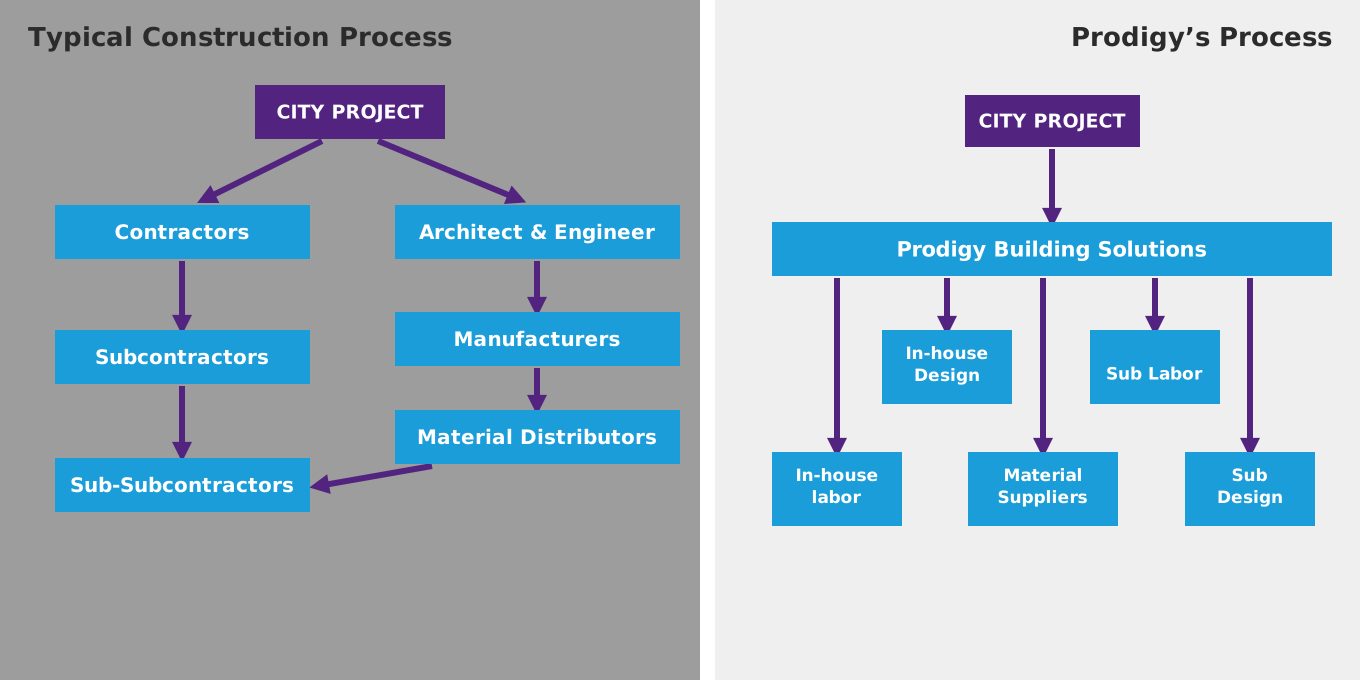
Figure 1: Cooperative Purchasing vs. Traditional Construction Procurement.
4. Get council approval. When you're ready, your council votes to approve the project (and, if you're not already a member, to join the COG — the two resolutions are often passed in the same meeting). Joining is a one-time step; once you're a member, you don't join again for future projects. There's typically no cost to join a COG — vendors pay the fees that cover its operations.
5. Build, then close out for audit. The contractor performs the work. On completion, the contractor works with the COG to produce a compliance letter documenting that the procurement met the cooperative's requirements — which you keep on file for your annual state audit. You pay the contractor directly; the contractor settles any COG fees.
What Still Applies — Even With Cooperative Purchasing
Cooperative purchasing exempts you from competitive selection and bidding — but only from that. Two obligations remain, and they're a large part of why the process stands up to audit rather than being a shortcut:
Council authorization and appropriation. The exemption doesn't create unilateral spending authority. Any expenditure above the statutory threshold in ORC 9.17 still requires council authorization and appropriation, exactly as it would otherwise.
Bonding. Performance and payment bonding under Ohio's Little Miller Act (ORC 153.54) still applies. It attaches to public-improvement work regardless of how the work was procured, and the vendor furnishes it.
Neither of these changes — which is precisely why an agency can use cooperative purchasing with confidence at audit time.
Why Agencies Choose It: Speed, Cost, and Control
Speed. Because the competitive-bidding requirements were already satisfied at the COG level, a cooperative project skips the single most time-consuming phase of traditional procurement. On a larger, complex project — a building renovation or a major HVAC upgrade — that alone can cut the timeline in half or more. A $15 million renovation that a cooperative contractor can complete in 9 to 12 months would routinely take 18 to 24 months through design-bid-build.
Lower design cost. Traditional projects carry architectural and engineering fees that typically run 6 to 12 percent of project cost. A contractor with genuine in-house architecture and engineering charges only direct costs — often closer to 1.5 percent.
A single point of contact. One contractor leads from start to finish, eliminating the finger-pointing that happens when responsibility is divided among an architect, engineer, general contractor, subcontractors, and the client — and something goes wrong.
Price transparency. Because the underlying contract is competitively bid on unit-based pricing, you have full cost visibility and confidence the project is both competitive and best value.
Scope flexibility. As noted above, an over-budget result is a conversation, not a restart.
Design built around how the building is used. The quiet advantage. When contractors and design staff with real field experience are involved before the design is finished, the result is a building designed for practical operation and maintenance — not one that merely satisfied a specification.
The Bottom Line
Cooperative purchasing isn't a way around Ohio's procurement laws — it's a path those laws deliberately created, and the COGs to use it are already in place. Once you know which cooperative fits your project, the process is straightforward: pick your vendor, design and budget together, get council approval, build, and close out for audit. The protections that matter — council appropriation, bonding, the annual audit — stay firmly in place. What's lifted is the procedural weight, leaving a faster project, at a lower cost, designed around how the building will actually be used.
For the right project — a renovation, a roof, an HVAC system, a facility that can't afford to sit half-finished for two years — it's simply a better way to build.
Want to understand whether cooperative purchasing fits a project your agency is planning? Contact Prodigy to talk it through.
Disclaimer: Prodigy Building Solutions is a design-build construction firm, not a law firm, and nothing in this article is legal advice. Cooperative purchasing is governed by specific provisions of the Ohio Revised Code, and the right procurement path depends on the particular project, agency, and cooperative involved. Any public agency considering cooperative purchasing should confirm the applicable requirements with its own legal counsel before proceeding.
Our Work